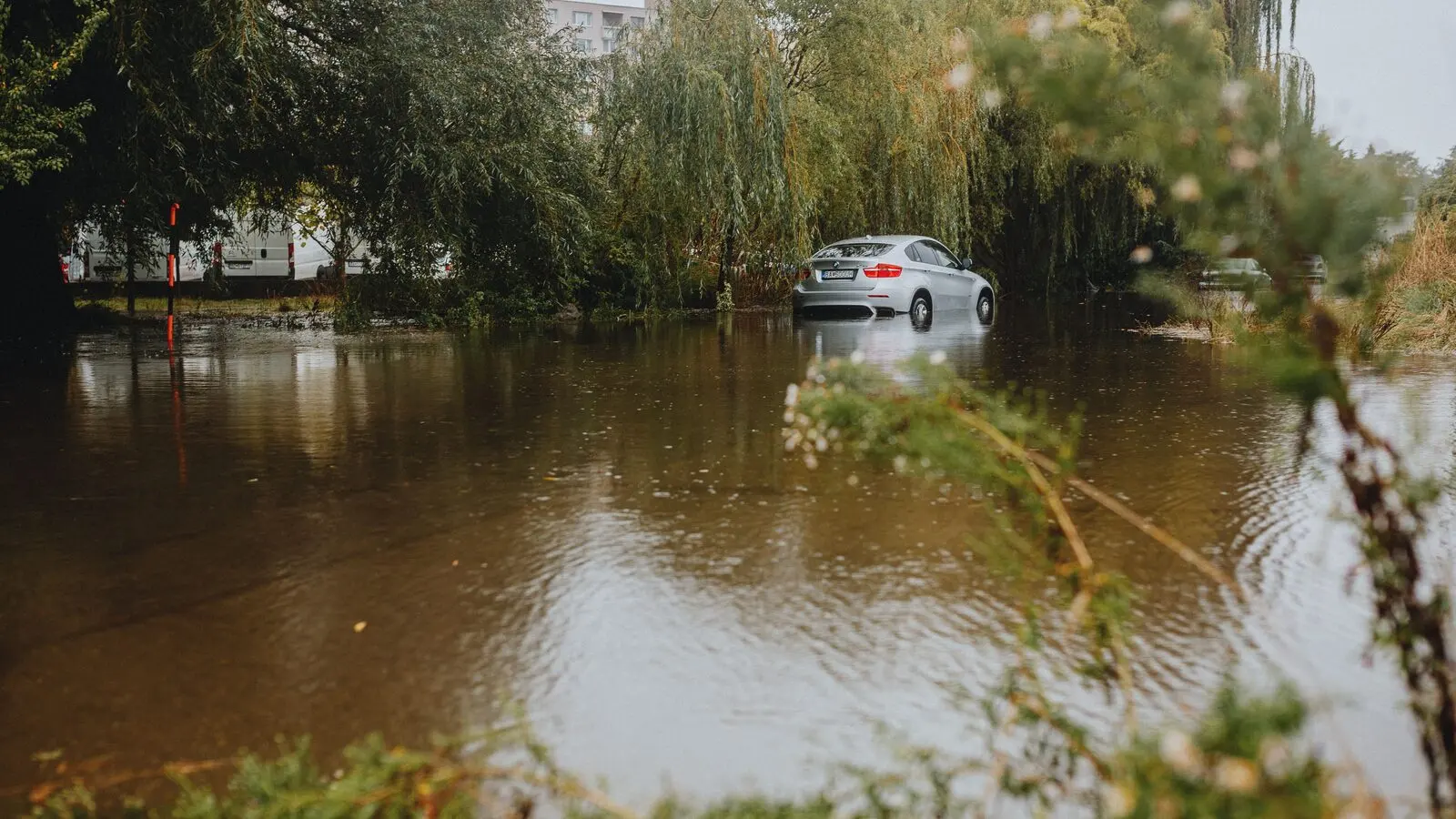
A severe downpour leaves a car submerged in water. A forest fire sweeps through a parking area and destroys dozens of vehicles. The first question is usually: "Who pays?" There is no one-word answer. It depends on the type of incident, the cover provided by the insurance policy, the current market value, the excess, the evidence and whether a third party is at fault.
Since 1 June 2025, a specific obligation has applied in Greece to insure vehicles against forest fire and flood. This is important, but it does not mean that every loss caused by water or fire is automatically compensated or that every policy has the same exclusions. The owner must read the policy and take the right steps during the first few hours.
Life first, vehicle second: do not attempt to cross a road or a low-water crossing that is covered by water. If the car becomes immobilised and is at risk of being swept away or flooded, follow the instructions of Civil Protection and leave the vehicle only if it is safe to do so.
1. The short answer: who may pay
Following loss caused by flood or fire, one or more of the following routes may be available:
- Your own insurer: when the risk is covered, the policy was in force and the notification and documentation requirements were met.
- The third party at fault or that party's insurer: when the loss is causally linked to another person's proven unlawful and culpable act or omission.
- A special state-aid scheme: only if an instrument is issued that covers the particular incident, the vehicle and the relevant category of beneficiary, and all conditions are met.
- The owner: for the excess, any amount above the insured limit, a risk that is not covered or loss that falls within a valid exclusion.
The fact that a severe weather event was described as "historic", or that an entire area was affected, is not in itself enough to establish entitlement to specific compensation. The correct legal and insurance basis must be identified.
2. What has applied since 1 June 2025 and the available exceptions
Article 26 of Law 5162/2024 inserted Article 5A into Law 5116/2024. In addition to third-party liability insurance, the owner or keeper of a motor vehicle whose place of normal parking is in Greece must insure the vehicle against forest fire and flood, on the basis of its current market value.
The rule has applied since 1 June 2025 and was further specified by Joint Ministerial Decision 94798 EX 2025, Government Gazette B' 2706/2.6.2025. The obligation does not depend on whether the vehicle is driven every day.
Article 5A(1) separately refers to compliance with the administrative immobilisation procedure. More specifically, under Article 1(2) of Joint Ministerial Decision 94798 EX 2025, a vehicle under administrative immobilisation is insured exclusively against forest fire and flood, on the basis of its current market value.
The exception for public-sector vehicles applies to vehicles owned by the State or by a public-sector body within point (a) of Article 14(1) of Law 4270/2014, with the local-government subsector (OTA) expressly excluded. It is therefore not a general exception for municipal or regional vehicles.
The Joint Ministerial Decision also provides an exception, subject to cumulative conditions, for lorries and commercial-use vehicles belonging to businesses with annual gross revenue exceeding EUR 500,000 in the preceding year. The exception applies when the vehicles are already covered under Article 5 of Law 5116/2024 for 100% of their current market value and that value is included in the insurance covering 70% of the value of the business's property, as specified in paragraph 2 of the same article.
This rule should not be confused with the pre-existing compulsory motor third-party liability insurance. Third-party liability insurance covers damage caused by the insured vehicle to others. The new cover concerns loss to the vehicle itself caused by the two specifically named natural hazards.
3. What the new obligation does not cover automatically
The phrase "natural disasters" is often used as a general heading, but the vehicle provision specifically names forest fire and flood. Without checking, it should not be assumed to include:
- hail, windstorm or a falling tree,
- earthquake or ground subsidence,
- water from a burst pipe, a garage leak or washing,
- an ordinary fire caused by an electrical or mechanical fault,
- arson, vandalism or a terrorist act,
- engine damage because the vehicle was driven through water.
Some of these risks may be covered by additional terms. The answer is found in the schedule of cover, the general and special terms, the exclusions and any endorsements to the particular policy, not merely in the package's commercial name.
4. How to check whether your loss is actually insured
Open your latest insurance policy and identify six points:
- Period of cover: the date and time when cover begins and ends.
- The precise risk: flood, forest fire, fire generally or another natural hazard.
- Insured value: the amount on which the maximum benefit is calculated.
- Excess: the part of the loss that remains payable by the insured.
- Exclusions: for example, intent, gross negligence where permitted by law, use contrary to the terms, or failure to take reasonable steps to limit the loss.
- Claims procedure: how to give notice, roadside assistance, the loss adjuster, the repair shop and required documents.
Ask the insurer to confirm in writing the claim number and the cover being considered. A statement over the telephone such as "it should probably be covered" is not enough when you are about to move, dismantle or repair the vehicle.
5. The first ten steps after a flood or fire
- Make sure the area is safe and follow the instructions of the Police, Fire Service and Civil Protection.
- Do not try to start a flooded vehicle.
- Call the insurer or the designated roadside-assistance service.
- Ask the competent authority for an incident number or certificate if it attended the scene.
- Photograph the vehicle where it was found, without putting yourself at risk.
- Record the water level, mud lines, burnt areas, nearby vehicles and the general condition of the area.
- Note the date, time, precise location, weather event and witnesses.
- Move the vehicle only in a safe manner and keep the towing receipt.
- Do not authorise repairs or disposal before an inspection has been made possible, unless urgent action is required for safety reasons.
- Keep a copy of every statement, email, photograph, estimate and receipt.
Do not "test" the engine: starting it after water ingress can turn limited damage into a serious mechanical failure. In addition to the technical cost, a dispute may arise over which part of the final damage was caused by the flood and which part by a subsequent action.
6. Which photographs and documents prove the loss
The documentation must show not only that the vehicle was damaged, but also when, where and by which event the damage was caused. Useful evidence includes:
- wide-angle photographs of the area and close-ups of the vehicle,
- unedited video showing the initial condition,
- photographs of the registration number and vehicle identification number where it is safe to take them,
- 112 alerts, announcements by the authorities and incident reports,
- a Fire Service or Police certificate, where one is issued for the case,
- towing and storage receipts,
- a technical diagnosis and itemised repair estimate,
- the vehicle registration certificate, insurance policy and proof of premium payment.
Keep the original digital files. Do not rely only on images that were sent through an app and compressed. Original metadata, the sequence in which images were captured and the communication history may help when the timing or extent of the loss is disputed.
7. When the loss must be reported to the insurer
Article 7 of Law 2496/1997 provides that the policyholder must notify the insurer within eight days of becoming aware that the insured event has occurred and must provide the necessary information, evidence and documents. This is not a reason to wait until the eighth day. In practical terms, the safe course is to report the loss immediately, using the method specified in the policy.
The mere expiry of the eight-day period does not automatically result in loss of the insurance benefit. Under Article 7(2) of Law 2496/1997, a culpable breach of the notification duty entitles the insurer to claim compensation for the loss it suffered as a result of that breach. A culpable breach of the duty to limit the loss, and the causing of the insured risk through intent or gross negligence, are separate issues.
Notice of loss is different from a "formal complaint", meaning a written complaint about how the company handled the matter. First, you open a claim file. If an unjustified delay, inadequate reasoning or a disagreement arises later, you submit a separate formal complaint.
Send the notice in a way that leaves a record: a form that issues a reference number, an email to the official address or another designated channel. Describe facts, not speculation. Do not sign a statement accepting a cause or an amount that has not yet been examined.
8. Loss adjuster, repair shop and the right to inspect
The insurer usually commissions an assessment to determine the cause, extent and cost of the damage. The loss adjuster is not a substitute for your own technical adviser. In a serious or disputed case, you may request an independent technical report, particularly before evidence is destroyed by cleaning or dismantling.
Ask for the engine, electrical and electronic systems, safety systems, airbags, the high-voltage battery in an electric or hybrid vehicle, the cabin, corrosion and possible contamination by water to be recorded separately. In the event of fire, the point of origin and spread must be documented, along with any indications of an external cause.
Do not discard parts or send the vehicle for recycling before the agreed procedure has been completed. If immediate action is necessary for safety reasons or to prevent greater loss, inform the company in writing and document the condition before and after the action.
9. Repair or total loss: how the amount is calculated
Compensation is not necessarily the same as the price you paid when you bought the car. The compulsory cover under Article 5A refers to current market value. In practice, consideration is given to the sum insured, the actual value immediately before the loss, the repair cost, the excess, any applicable limit, and the terms concerning residual value or salvage.
If the cost of safe restoration is disproportionate to the value, or if the vehicle cannot be restored reliably, it may be classified as an economic or technical total loss. Ask for the following in writing:
- the pre-incident value accepted by the company,
- the valuation method and comparable data used,
- the estimated repair cost,
- the excess and every deduction,
- how the vehicle's salvage will be dealt with.
Advertisements for vehicles with very different mileage, equipment or condition are not, by themselves, a reliable comparison. Gather the service book, records of recent repairs, the roadworthiness inspection record and evidence of the vehicle's actual condition before the incident.
10. When compensation may be disputed or refused
Common areas of disagreement include:
- the risk is not included in the cover,
- the policy had expired or had not yet begun,
- the cause was different from the one reported,
- part of the damage already existed,
- the damage increased after the incident, for example because a flooded engine was started,
- there was no opportunity to inspect the vehicle before repair or disposal,
- an excess, limit or underinsurance affects the amount,
- the company relies on a specific exclusion in the policy terms.
A refusal must be assessed against the insurance policy, the facts and the law. A general reference to "negligence" or a "weather event" is not enough unless it is linked to a specific term and supporting evidence. Conversely, the existence of cover does not invalidate every lawful exclusion.
11. What happens with state aid
Joint Ministerial Decision 94798 EX 2025 provides that an owner or keeper who failed to comply with the insurance obligation is excluded from every state-aid grant for the vehicle where a forest fire or flood occurs on or after 1 June 2025.
The converse does not apply automatically: having insurance does not necessarily mean that you are also entitled to state support. A specific scheme or decision for the particular disaster, an eligible category of loss, a timely application and the required supporting documents are necessary. Double compensation for the same loss must also be avoided.
Check only official announcements from the Ministry for Climate Crisis and Civil Protection, the Region, the Municipality and other competent authorities. Do not rely on earlier measures for another disaster, because eligible beneficiaries, amounts and deadlines vary from one instrument to another.
12. If a third party, the Municipality or the operator of a site is responsible
A natural disaster does not rule out third-party liability in advance. A separate claim may be considered where, for example, a fire began because of a proven unlawful act, a dangerous object fell due to inadequate maintenance, or a specific omission by the competent body contributed causally to the loss.
Such liability is not presumed merely because a road flooded or the weather event was severe. A specific unlawful act or omission, damage and a causal link are required. A claim against a public body is governed by a different legal framework and falls within the jurisdiction of a different court from a private dispute.
Inform the insurer if there is evidence identifying a third party at fault. Once compensation has been paid, the insurer may be subrogated to your rights up to the amount it paid. Do not sign a waiver or full and final settlement in favour of a third party without checking whether it affects another claim.
13. Special care with an electric or hybrid vehicle
Contact between a high-voltage battery and water, or thermal stress, requires specialist handling. Do not touch exposed cables, attempt to charge the vehicle or transport it in an unapproved manner. Follow the instructions of the authorities, the manufacturer, roadside assistance and a suitably qualified technician.
Ask for diagnostic codes, battery condition, insulation and the cooling system to be documented. Follow any specific isolation, transport or storage instructions given by the manufacturer, roadside-assistance provider, Fire Service or a suitably qualified technician. External appearance may be misleading. A high-voltage fault may not be visible, while the requirements for safe restoration may have a decisive bearing on whether the vehicle is assessed as a total loss.
14. What to do if you disagree with the insurer
First request the company's full position in writing: which cover was considered, which term was applied, which facts the company accepted and how it calculated the amount. If the disagreement remains, submit a formal complaint to the insurer's dedicated complaints-handling function.
According to the Bank of Greece, the company must provide a written, reasoned response within fifty calendar days of the submission of the formal complaint. A formal complaint is not the initial notice of loss or a simple request for payment.
If no timely or substantiated response is provided and the matter is supervisory in nature, a complaint may be filed with the Bank of Greece. The Bank does not award compensation in private disputes and does not act as a court or mediation body. Depending on the case, recourse to the Greek Consumer Ombudsman, another alternative dispute-resolution body or the courts may be considered.
15. The file you should have before seeking legal review
- the insurance policy, general and special terms, and endorsements,
- proof of payment and the precise period of cover,
- notice of loss and the claim-file number,
- photographs, videos and original files,
- certificates from the authorities and details of the disastrous event,
- the insurer's assessment and your own technical report,
- estimates or invoices for repairs, towing and storage,
- the written compensation offer or refusal,
- the formal complaint and the insurer's response,
- details of any third party at fault and witnesses.
An organised file makes it possible to answer the essential questions quickly: was there cover? Is the insured risk proven? Was the value calculated correctly? Was the exclusion applied lawfully? Is there an additional claim against a third party?
16. What to check before the next severe weather event
Do not wait for an incident before reading the insurance policy. Before each renewal, ask for written answers to the following questions:
- Are flood and forest fire covered separately?
- Is there broader cover for fire, hail, storm or falling objects?
- What are the insured value and the current market value?
- What excess applies to each risk?
- Are towing, storage and decontamination costs covered?
- Are there special terms for underground premises, a geographical area or immobilisation?
- Which telephone number and email address should be used to give immediate notice?
Also check that the vehicle's value has not remained unchanged for years without justification. The statutory obligation refers to current market value. An unclear or outdated amount may become the central issue in a dispute after a loss.
Practical rule: keep a PDF of the insurance policy, the roadside-assistance number and pre-loss photographs of the vehicle both on and away from your phone. If the device is lost or destroyed in the same incident, the copy held on a second secure medium may prove decisive.
17. Frequently asked questions
If the car was under administrative immobilisation, did it need flood and forest-fire cover?
Yes. The Joint Ministerial Decision provides that a vehicle under administrative immobilisation is insured only against these two risks, at its current market value.
Does basic third-party liability insurance cover my own flooded car?
Not by itself. Third-party liability insurance concerns damage caused to others. The vehicle itself requires the corresponding cover for flood damage or another agreed form of cover.
Water entered the cabin, but the car still runs. Should I drive it?
Not before it has been assessed safely. There may be water in the electrics, safety systems, lubricants or battery. Contact roadside assistance and a suitably qualified technician.
If I did not have the compulsory cover, will the State compensate me?
The current rule excludes a person subject to the insurance obligation who was uninsured from state aid for the vehicle when the loss results from forest fire or flood after 1 June 2025.
Must the insurer respond within 50 days?
The period of 50 calendar days concerns the written response to a formal complaint. It does not turn every notice of loss into a formal complaint or, by itself, determine when each loss assessment must be completed.
Can I have the vehicle repaired immediately and send the invoice afterwards?
Only after checking the procedure and informing the insurer. A premature repair may destroy critical evidence. Urgent safety measures must be fully documented.
18. Official sources and review date
The legal and practical information was reviewed on 23 August 2026 on the basis of the following sources:
- Hellenic Parliament: Law 5162/2024, Article 26.
- Joint Ministerial Decision 94798 EX 2025, Government Gazette B' 2706/2.6.2025.
- Hellenic Parliament: Law 2496/1997 on insurance contracts.
- Bank of Greece: formal complaints and complaints concerning private insurance.
- Ministry for Climate Crisis and Civil Protection: flood guidance.
- Gov.gr: compulsory motor vehicle insurance.
- Ministry for Climate Crisis and Civil Protection: news and state-aid announcements.
- Greek Consumer Ombudsman: filing a complaint.
Insurance terms, company procedures and state-aid schemes change. Check the policy and the instruments in force on the date of the incident. This article provides general information and is not a substitute for individual legal or technical advice.



Comments
Share your thoughts about this article.
No comments yet. Be the first to comment.
Submit a comment