Archive note: This text comes from the old archive of Nomika Epilekta and is preserved with care for historical and informational reading.
- Which children need platelets?
Children hospitalized in pediatric oncology clinics undergo many cycles of treatment in order to root out the malignant disease from their bodies. The intensity of the treatments is the maximum possible, depending on how many side effects the young patient can face. To deal with the immediate side effects of the treatments, doctors often administer a blood derivative, platelets, which help blood clot.
- Search for platelet donors by Lampsi in emergencies
The blood donation departments of hospitals, as well as parents in general, take care to find suitable platelet donors. Unfortunately, there are not always enough available donors with the appropriate blood type. Parents often turn to Lampsi. In these urgent cases, Lampsi informs its members about the problem through mass SMS messages. They, in turn, personally inform their social circle about the need to find a suitable platelet donor. In the same way, volunteers who have asked in advance to be included in the notification process are also informed. Prospective donors who are moved to help should themselves contact the hospital blood donation services by telephone and state their availability. Usually two or three donors are enough to cover a child's urgent needs. The remaining donors may, if they wish, declare themselves available to the blood donation service for a future need of the same or another child.
- What can you do?
If you also wish to receive notifications from Lampsi about possible urgent needs of children for platelets, please inform us by telephone at 2310-943396, Ms. Lina, or at aimopetalia@lampsi.org. In the same way you may also inform us not to send you our notifications if you do not wish to receive them for any reason. We also list useful telephone numbers for the blood donation departments of AHEPA, 2310-993390 and 2310-993405, and Ippokrateio, 2310-892816. Lampsi does not keep a donor file; it simply makes sure to inform its members and volunteers who have themselves requested relevant communication about urgent needs.
- Informational material
For convenience, we provide information based on material from the blood donation station of the Regional University General Hospital of Heraklion and the Blood Center of the Thessaloniki General Hospital AHEPA, PLATELET DONATION
- What is plateletpheresis?
Blood is a mixture of red and white blood cells, platelets, plasma, and other elements. Plateletpheresis is a special blood donation procedure that allows you to offer only one element of your blood: platelets, the cells that help bleeding stop. There is an excess of platelets in our blood, and many of them can be removed without any side effect for the donor. The removed platelets are restored within a few days.
- History of plateletpheresis
Until recently, the only way to collect platelets was to separate them from the blood offered by the blood donor. From each unit of whole blood, a small quantity of platelets is collected at the blood donation service. Today, however, advanced medical machines known as "cell separators" allow us to collect many more platelets from a single donor. The separators remove the platelets from the blood you donate and return the remaining blood elements to you. The whole process is simple, safe, and very similar to the usual blood collection procedure.
- How is plateletpheresis performed?
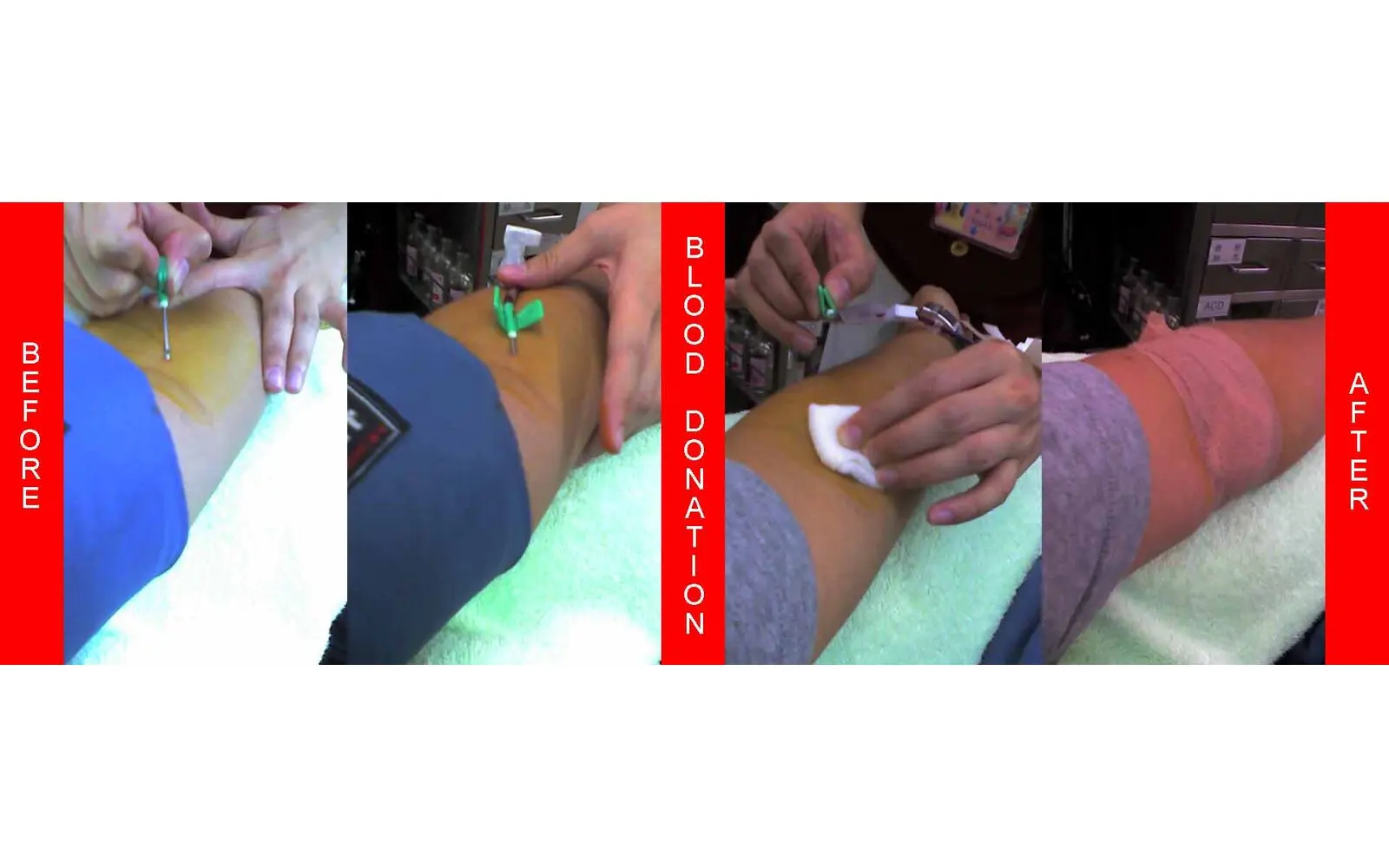
The donor lies next to a machine, a vein is punctured, and from a small amount of blood passing through the machine the platelets are separated automatically. The rest of the blood returns to the donor through the same arm. Plateletpheresis lasts one to two hours. The whole procedure is longer than ordinary blood donation because more time is needed to separate and collect the platelets from the other blood elements. Collection is almost always performed at the hospital where the young patient is hospitalized, and as far as possible only a few hours before administration. Platelets are not preserved for many days, nor are they easily transported from hospital to hospital. For these reasons, covering needs between hospitals is much more difficult, even impossible, compared with whole blood.
- What is the importance of your donation?
The donation of platelets helps children who present thrombocytopenia because of serious health problems such as leukemia, cancer, or aplastic anemia. Often the survival of these patients depends on a platelet transfusion.
- Who can give platelets?
The requirements that platelet donors must meet are almost the same as those for whole blood donors. You must be in absolutely good health, weigh more than 50 kilograms, not be taking chronic medication, and not have taken aspirin during the last five to six days. In addition, you must have "good veins" and a platelet count above a specific threshold. Also, before someone gives platelets, that person must come to the blood donation service and give a blood sample for laboratory tests four to five days before platelet collection, so that the platelets can be administered immediately after they are collected. Women with more than two pregnancies and carriers of sickle cell trait, about 1% of Greeks, should not give platelets. There is always the possibility that a donor will complete all preliminary hematological tests but ultimately will not be called to give platelets at all, if the patient's condition improves in the meantime. Unfortunately, if there is no specific need for a specific child-recipient, platelets are never collected, since platelets are not stored for more than five to seven days, usually five, while the collection and processing disposables are extremely expensive. This may seem like unnecessary inconvenience on the donor's side, but for the young recipient and the parents it gives a feeling of relative security that the child will not be left uncovered before the risk of thrombocytopenia and spontaneous internal bleeding. That alone is worth the effort.
- Does plateletpheresis hurt?
Plateletpheresis, like ordinary blood donation, is not painful. You will feel only a slight prick when the needle enters the vein of your arm.
- Is plateletpheresis safe?
Plateletpheresis is very safe. There is no risk of infection because the entire procedure takes place in a closed and sterile circuit. Hematocrit does not fall because the red blood cells are returned to the donor, so there is no risk of dizziness or fainting and no risk of iron deficiency. If paresthesias, or numbness, appear because of the anticoagulant, they are treated easily and quickly by taking calcium. Throughout the procedure you are supervised by specialized staff.
- How often can I give platelets?
Every 15 days, if needed.
- If I give platelets, can I also give blood?
Yes, provided that at least 48 hours have passed since the last time you gave platelets. If you recently gave blood and are asked to give platelets, you may do so if one month has passed since the last time you donated blood.
- Why should I become a platelet donor?
Every time you give blood, someone or several people benefit. This is even more true for platelet donation. You can be certain that your platelet donation helps a child with very specific and serious health problems. It truly helps save a child's life. Is there a more serious reason to become a platelet donor? Source: http://lampsi.org/?page_id=1261&fb_source=message



Comments
Share your thoughts about this article.
No comments yet. Be the first to comment.
Submit a comment