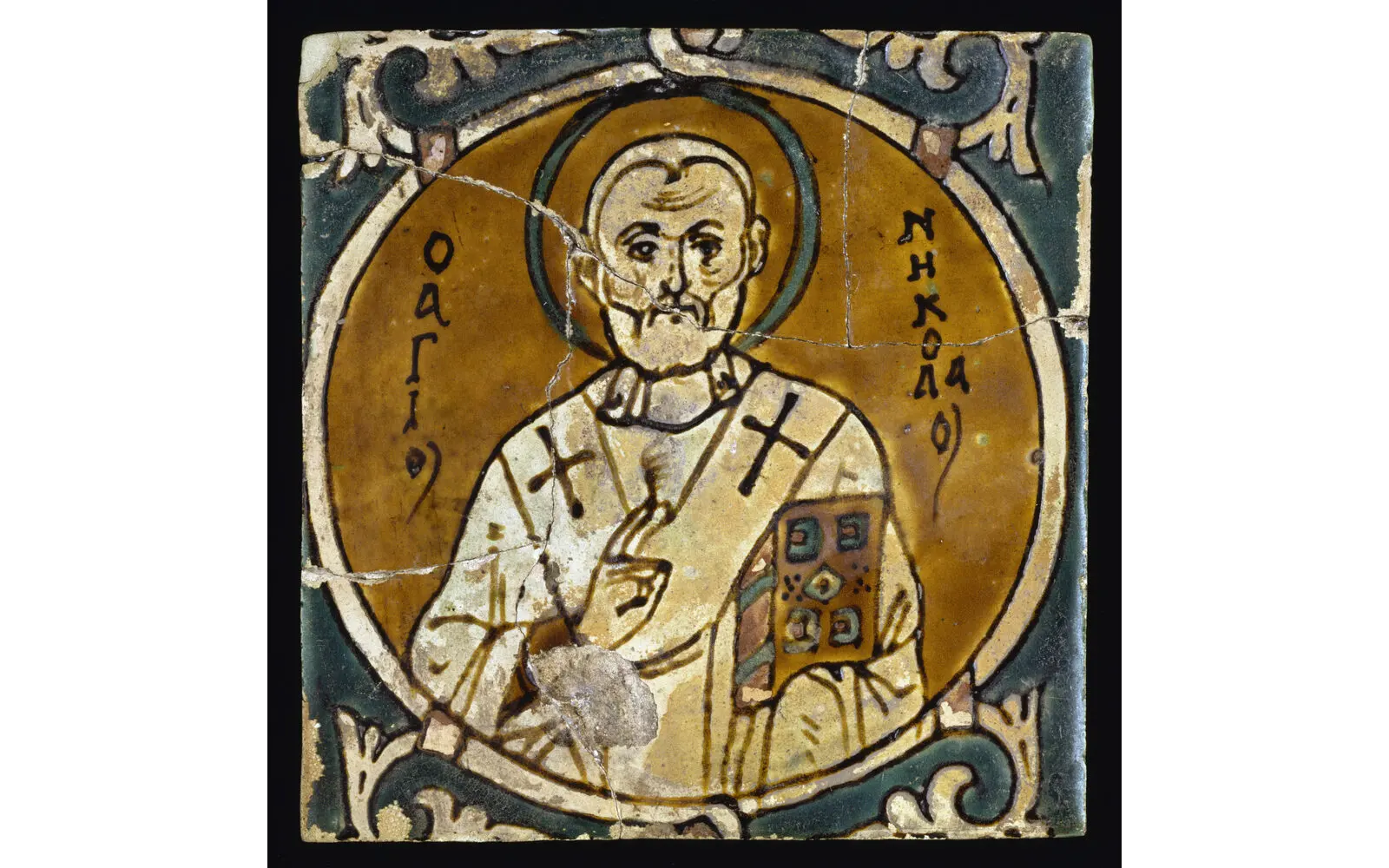
Archive note: This text comes from the old archive of Nomika Epilekta and is preserved with care for historical and informational reading.
In the period of crisis we are going through, an economic, moral and spiritual crisis, precisely now the need becomes more urgent to rediscover our moral and spiritual identity, to return to our roots, to the principles and ideals of our ancestors who created two great civilizations, ancient Greek and Byzantine. In the text that follows, briefly, we shall learn or remember the chronicle of Byzantine art and more specifically of Byzantine painting. Byzantine art is the art of the Greeks in its Christian expression, as it manifested itself during the long history of the Byzantine state from 324 to 1453. The existence of Byzantine icons is attested from the beginning of the 4th century AD, and their origins go back to ancient Greek art, to portraits of Roman emperors and their families, to depictions of gods from pagan and mystery religions, while their roots lie in the Egyptian Fayum portraits, dated to the 1st to 3rd century AD and constituting the oldest form of portraiture, figure 1. (Fig. 1 Portrait of a young woman from Fayum, with the characteristic pose that female figures would retain in Byzantine art. Athens, Benaki Museum) These portraits gave much to Byzantine painting and form the connecting link between ancient Greek art and Byzantine art. Common characteristics are the large, overemphasized eyes with strong outlines, the intense gaze and the tightly sealed lips. Also common are the frontality of the figures and the three-quarter pose that we also find in Byzantine art. Common points also exist in the technique, the working methods and the materials of construction. For example, the wooden support, the preparation of the wood and the dark underpaintings. Other common features are the techniques of encaustic and tempera and the presence of gilding. The oldest surviving Byzantine icons have been found at Sinai; they are wax-based and are attributed to Constantinopolitan workshops, see figure 2. (Fig. 2 The Pantokrator of the Sinai monastery, 6th century AD.) We could divide the history of Byzantine iconography into periods according to the major historical events that took place: I) The first centuries until iconoclasm, 724 AD, Early Byzantine and pre-iconoclastic times. II) The years of iconoclasm, 730-845 AD. III) The iconography of the Macedonian and Komnenian dynasties, 867-1204 AD. IV) The Palaiologan Renaissance, 1204-1453 AD. In the first centuries of Christianity, the early Christian period, an archaic, symbolic art begins timidly to appear: the art of the Catacombs. The catacombs were underground labyrinths where Christians took refuge to pray during the persecutions, and at the same time they were cemeteries. The symbols of catacomb art include themes of water, Noah’s ark, Jonah in the garden, Moses, the fish, the anchor; symbols with the theme of bread and wine, the multiplication of the loaves, the ears of wheat, the vine; and symbols referring to images of salvation, the children in the furnace, Daniel among the lions, the Good Shepherd, figure 3. It began with traditional motifs received from pagan art, and its purpose is purely didactic. Even the colors have symbolic significance. (Fig. 3 The Good Shepherd. Wall painting, Catacomb of Priscilla, Rome, second half of the 3rd century AD. Early Christian period) Next we have the Early Christian period, when notable iconography developed in the art of mosaics. To the same period belong important wall paintings made with the technique of fresco, wet plaster painting, such as those of Castelseprio near Milan, 6th-7th century, where the fixed characteristics of Byzantine art, such as centripetal lighting, had already begun to take shape. The portable encaustic icons of the Sinai monastery also belong to the Early Christian period, figures 2 and 4.
(Fig. 4 The Virgin and Child, Saints Theodore Stratelates and George and angels, second half of the 6th century. Monastery of Saint Catherine, Sinai. Early Christian period) During the period of iconoclasm, 730-845 AD, that followed, there was a setback in the development of art. The iconographic type was replaced by decorative motifs. During iconoclasm, the production of icons continued in regions outside the Byzantine state. Icons attributed to this period have survived at Sinai and in Palestinian workshops. In many cases figurative decorations are covered with aniconic ones. The new works, which do not appear to have been many, decorate the churches with geometric, vegetal and zoomorphic designs, as in Naxos, see figure 5. (Fig. 5 Aniconic representations with flowers and geometric themes. Saint Artemios at Sagri, Naxos, 9th century. Detail from the decoration and the inscription on the arch of the sanctuary) After the iconoclastic disputes we have the renaissance of Orthodox icon painting during the Macedonian and Komnenian period, also called the Middle Byzantine period. This is an important period of Byzantine painting, which Charles Delvoye calls the classical age of Byzantium. First of all, then, the Pantokrator was painted in the domes of churches. A famous work of this period is the church of Hagia Sophia in Ohrid, 1040-1045 AD. The wall paintings of this church are representative of Byzantine icon painting as it later took shape. The icon of the Theotokos of Vladimir also belongs to this era. Then follows the Palaiologan Renaissance, 1204-1453 AD, or Late Byzantine period, characterized by fertile, creative activity. The scholars of Palaiologan painting, and chiefly the Frenchman Millet, divided it into two schools, the “Macedonian” style and the “Cretan” style. The Macedonian school flourished mainly in Macedonia, with Thessaloniki as its center, and for this reason it was called Macedonian. Its chief exponent was Manuel Panselinos, who painted the chapel of Saint Euthymios in Thessaloniki and the Protaton in the first half of the 14th century, figure 6. (Fig. 6 The daughters of the Hebrews with the little Virgin Mary. Detail from the wall painting “The Presentation of the Virgin”. Manuel Panselinos. Mount Athos, Protaton) The Macedonian school passed from Constantinople to Mystras at the end of the 14th century. There the art was expressed in portable icons as a strict style and gave rise to the Cretan school. Its chief exponent is Theophanes the Cretan, who painted Saint Nicholas Anapausas at Meteora, 1527, the katholikon of the Great Lavra and the katholikon of the monastery of Stavronikita , 1546. The characteristic of art during the 15th, 16th and 17th centuries, that is, the period of the Renaissance and the baroque in the West, is its intensely conservative character. This is manifested in adherence to the principles of Byzantine technique and in steady resistance to the natural penetration of western elements. Even the assimilation of elements in some cases was done in such a way that, although the elements are clear, they do not offend the principles and rules of Byzantine art. At the end of the 16th and during the 17th century, portable icon painting flourished, with its principal representatives being Michael Damaskenos, figure 7, Tzanes, Lambardos, the Serb Longinos and others, who had received western influences. (Fig. 7 Michael Damaskenos, second half of the 16th century. “The Nativity”) After the capture of Crete by the Turks in 1669, this great artistic center faded. Then the icons produced in the Ionian Islands began to stand out, where the technical and aesthetic principles of Byzantine painting had been enriched and renewed with western elements. In the then still Venetian-ruled Ionian islands, the descendants of the Cretans tried to preserve their tradition, enriching it with new, mainly allegorical, iconographic themes. In the years of slavery and sorrow under Ottoman rule, in the Greek territory, mainly from the 17th century onward, Byzantine painting almost disappeared and western painting prevailed. Many exquisite works of art were overpainted, and Byzantine painting was pushed aside and forgotten for many years. At the same time, many folk icon painters left a large number of works that do not follow the rules of Byzantine icon painting, while in most cases correct proportions and drawing are set aside. In the 18th and 19th centuries, and until the beginning of the 20th, folk art flourished, with Theofilos as its chief exponent. The characteristics of folk art strongly express the spirit of the era. The desire and hope for liberation from the Turkish yoke become the cause for the creation of icons with warrior saints, painted with open stride, billowing garments, armed and mounted, while landscapes, still lifes and genre scenes are incorporated into the composition. Byzantine icons became widely disseminated in other Christian countries as well, such as Georgia, and chiefly in countries that were Christianized by Byzantium and maintained close ties with it, such as Bulgaria, Serbia and Russia. Byzantine painting, then, is part of our Byzantine heritage, historical testimony and a connecting link in the history and culture of all peoples, and therefore part of the world heritage of humanity. It is a living art that we must preserve and hand down to the next generations. Bibliography:
- GREEK ART. Panagiotis Vokotopoulos. Byzantine Icons. Ekdotiki Athinon.
- Charles Delvoye. Byzantine Art. Papadimas Publications. Athens, 1994.
- Euphrosyne Doxiadis. “The Fayum Portraits”.
- Dionysios of Fourna. INTERPRETATION OF THE ART OF BYZANTINE PAINTING. By A. Papadopoulos-Kerameus. Kon. Char. Spanos - Athens, 1997.
- The Craftsman’s Handbook. Daniel Thompson.
- PLINY THE ELDER. ON ANCIENT GREEK PAINTING. AGRA PUBLISHING.
- GREEK ART. Myrtali Acheimastou-Potamianou. Byzantine Wall Paintings. Ekdotiki Athinon.



Comments
Share your thoughts about this article.
No comments yet. Be the first to comment.
Submit a comment