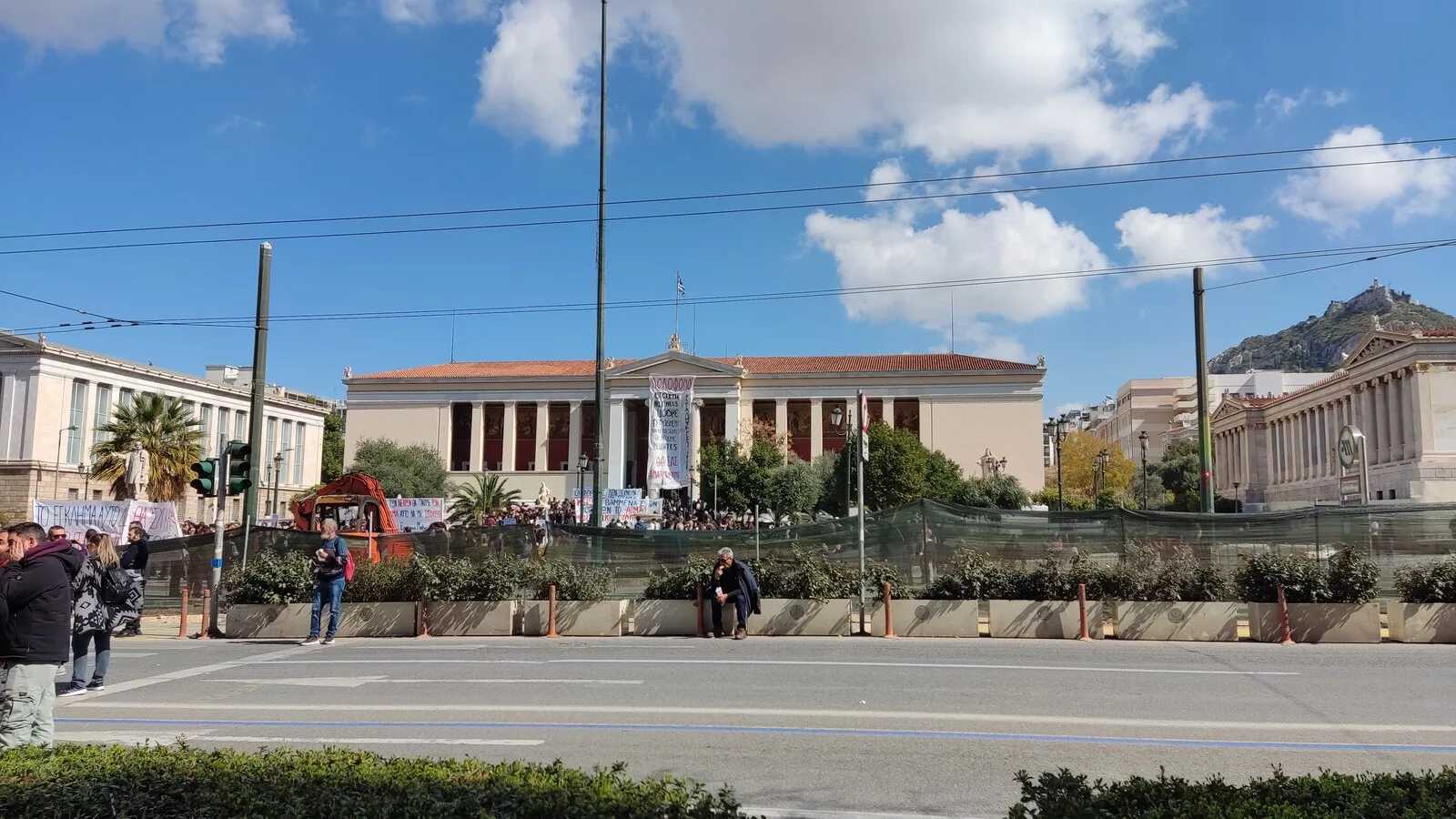
The left has dominated the universities for approximately fifty years. The question is simple: is there anyone in Greece who truly believes that university asylum - the free circulation of ideas in university lecture halls - is endangered? No one, except those who identify university asylum not with the free circulation of ideas, but with the free circulation of vandals and masked groups inside the university.
Millions of people read, hear and see that university asylum is violated daily by those for whom it exists. It is violated by small left-wing or far-left groups, students and non-students alike, who often cause damage and sometimes serious destruction.
University asylum is abolished by those who claim to protect it, mainly by left-wing or far-left students and by some rectors and professors acting with cooperation or tolerance. They have become professionals in violating university asylum and in organizing occupations.
It is also abolished by the so-called known-unknown persons. Perhaps the phrase has faded because they are now known very well. They describe themselves as leftists, far-leftists, anti-authoritarians, anarchists or progressives. In this text they are treated as part of a regressive political company that acts in the name of progress while producing disorder.
In many cases these groups are social offshoots, political remnants or personalities whose words and actions are dominated by totalitarian reflexes. Some come from political and economic establishments and therefore enjoy a kind of immunity.
Some wear hoods during demonstrations so they can destroy property without being recognized. They hide their faces when committing unlawful acts, such as property damage, theft, robbery or violence. They destroy in order to confirm their existence while being politically empty.
The tragic point is that parties of the left have participated in or supported violations of university asylum. It is even more tragic that center-right and center-left parties were, for years, unable to enforce the laws they themselves enacted. Failure to enforce the law is a sign of political underdevelopment. When violations are accompanied by destruction, it is also a sign of cultural underdevelopment.
Whenever a professor or student dares to express a view contrary to this dominant discourse, a totalitarian mechanism is immediately mobilized against that person, both verbally and physically. Violence is used against the one who dares to speak.
When students reach the point of using violence against their teachers and destroying university property, the situation is extremely serious. It is serious for those who participate in such acts, and also for those who support or justify them.
The phenomenon of occupations and violence has passed into schools as well. Those who lead pupils into occupying their schools bear responsibility. They tell children that occupation is their right, and they present it as democratic and progressive. Children may not be able to understand that any form of violence - and an occupation is an obvious form of coercion - cannot be either a right or a democratic act.
An even greater distortion occurs when the principle of majority rule is used to legitimize an occupation. Pupils say that the majority decided to occupy. But a majority cannot decide whatever it wishes: it cannot prevent teachers from entering school, discriminate against younger pupils, paint classrooms in party colors or demolish a nearby house. Majority rule is not a license for unlawful coercion.
Violations of university asylum and every form of occupation are unlawful and anti-democratic acts. The reaction to legislation on university security shows precisely why the law is necessary. If the law is applied, the domination of universities by disorder will end. That is why there is resistance. To be continued.



Comments
Share your thoughts about this article.
No comments yet. Be the first to comment.
Submit a comment