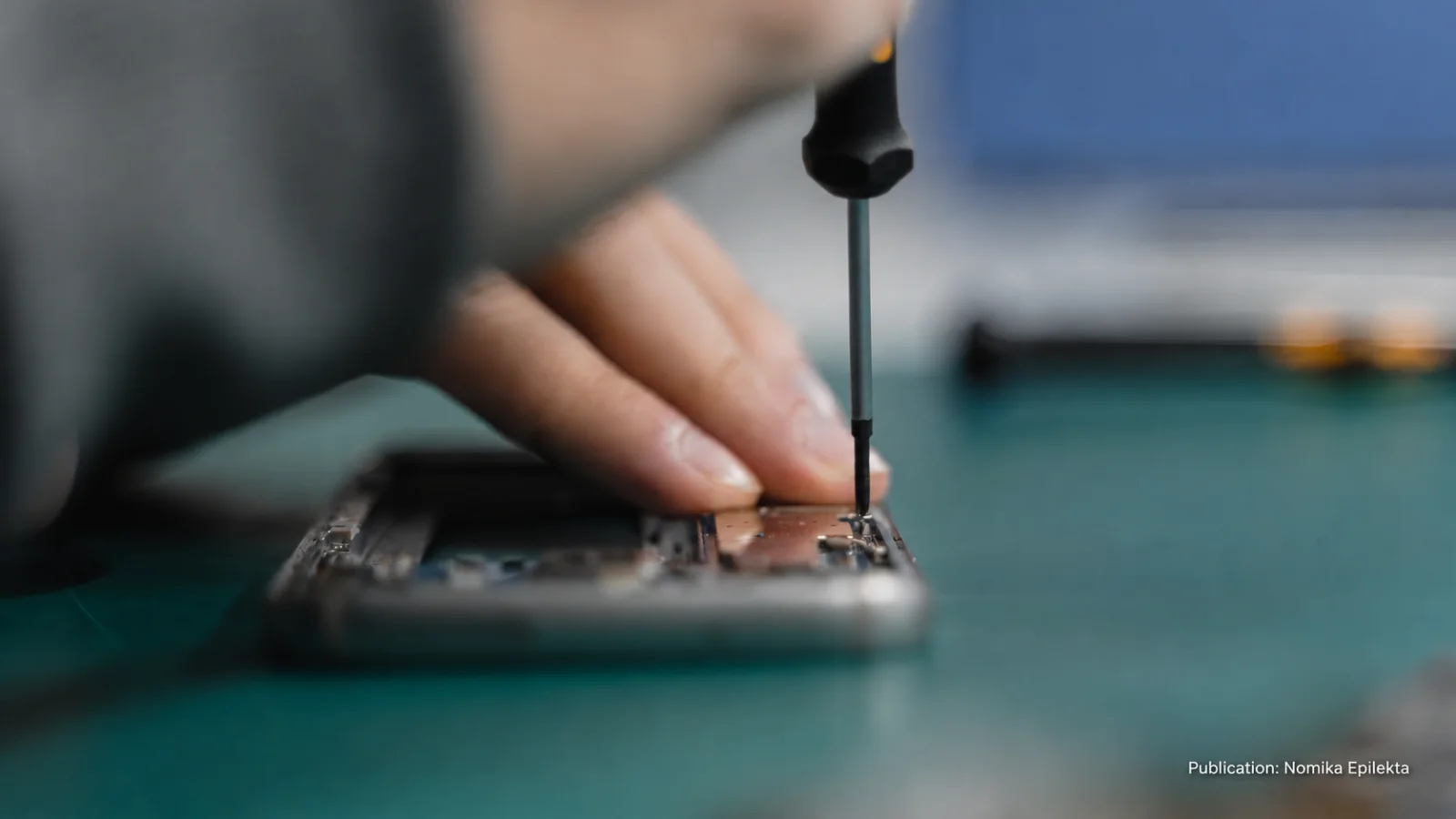
A phone can remain perfectly usable for years and then become difficult to use because of one failed component: a worn battery, a cracked display, a damaged charging port, or a camera module that no longer focuses. Greece now has a more precise legal framework for keeping repair available. Law 5317/2026 transposed Directive (EU) 2024/1799, and the Greek repair provisions apply from 31 July 2026.
The reform is important, but its limits are equally important. It does not make every repair free, it does not give every old purchase an automatic extra year of warranty, and it does not oblige manufacturers to support every mobile phone forever. A reliable answer depends on the device, the date on which its model was placed on the EU market, the cause of the fault, and whether the consumer is invoking a conformity remedy against the seller or the later repair duty against the manufacturer.
1. What changed on 31 July 2026
Law 5317/2026 was published in Greek Government Gazette A 108/10.7.2026. Its repair provisions added rules to Law 2251/1994 on the European Repair Information Form, the duty to repair specified goods, consumer information, and the relationship between repair and replacement. Part D applies from 31 July 2026 and implements the policy choices of Directive (EU) 2024/1799.
The new rules operate alongside the existing law on sales and legal conformity. They do not replace a seller's responsibility when a product fails to conform to the contract. They create a separate route intended to make repair a credible option after the seller's statutory liability period has expired, but only for products and to the extent covered by EU repairability requirements.
2. Start by choosing the correct legal route
If the phone lacks conformity with the sales contract during the seller's liability period, the consumer addresses the seller. Repair and replacement are remedies for restoring conformity, subject to the statutory conditions. A manufacturing defect, a missing promised function, or premature failure may belong in this route. Accidental damage, normal wear, or damage caused by misuse does not automatically become a free conformity remedy.
The later repair route is different. For covered products, the manufacturer must repair free of charge or for a reasonable price and within a reasonable period, unless repair is impossible. If the manufacturer is outside the Union, responsibility passes through the EU chain to its authorised representative, then to the importer, and, if neither exists, to the distributor. The request should state expressly which route is being used.
3. Which phones and related devices are covered
Regulation (EU) 2023/1670 covers smartphones, mobile phones other than smartphones, cordless phones, and slate tablets placed on the Union market. Its ecodesign requirements apply to devices placed on the EU market from 20 June 2025. The consumer's retail purchase date is useful evidence, but it does not by itself establish the model's first placement on the market or the remaining support period.
The category is not unlimited. The Regulation excludes, among other products, tablet computers outside the slate-tablet category, smartphones for high-security communications, and products with a rollable flexible main display. Smart watches and unrelated portable electronics are not pulled into the mobile-phone regime merely because they use a battery and a screen. Coverage must be checked against the exact product definition and the applicable EU act.
4. Who must provide the repair
The primary post-liability duty rests with the manufacturer. Where that manufacturer is established outside the EU, the authorised representative performs the obligation. If there is no authorised representative, the importer is responsible; if there is no importer, the distributor is responsible. This ladder prevents a brand from leaving consumers without a Union-based addressee solely because its corporate headquarters are elsewhere.
Before making a request, record the exact model, serial number or IMEI where necessary, purchase evidence, the fault, prior interventions, and the identity of the EU economic operator. A request to the retailer for non-conformity and a request to the manufacturer's repair network are not interchangeable. Sending a precise written request avoids the common response that the consumer contacted the wrong company or relied on the wrong guarantee.
5. Free repair and the meaning of a reasonable price
Directive 2024/1799 allows the covered repair to be supplied free of charge or at a reasonable price. It does not set one numerical ceiling for all brands, models, and failures. A price should not be fixed at a level that deters repair in practice. Public indicative prices for typical repair services and transparent spare-part prices are intended to make comparisons possible.
Ask for a breakdown of diagnostics, labour, part, shipping, tax, and optional work. A paid repair after accidental damage is not treated in the same way as a no-cost remedy for a lack of conformity attributable to the seller. A quotation should also make clear whether the fee remains due if the consumer declines the repair after diagnosis and whether any storage or return charge may arise.
6. Reasonable time, diagnosis, and the repair form
Repair must be completed within a reasonable period from the time the manufacturer takes physical possession of the goods, receives them, or is given access to them. The law does not impose one universal number of days for every fault. Technical complexity, transport, and the availability of a regulated part may matter, but they do not justify an indefinite queue without a date or an explanation.
A repairer may provide the European Repair Information Form before the consumer is bound by a repair contract. The form identifies the repairer, the product and defect, the proposed work, the price or maximum/calculation method, the estimated time, any loan device, the place of delivery, and additional services. Providing this standard form is optional. The form itself is free, while a necessary diagnostic service may be charged if the consumer was informed before the diagnosis.
7. Loan devices and refurbished alternatives
During repair, the manufacturer may lend a replacement product free of charge or for a reasonable fee. Greek sales-remedy rules also allow the seller to provide a temporary replacement without charge while restoring conformity, taking account of the nature of the goods and the buyer's needs. The word “may” matters: there is no unconditional right to a premium loan phone in every repair case.
If repair is impossible, the manufacturer may offer a refurbished product. That possibility is not an automatic right to a free new device, nor may a business silently substitute a refurbished phone without clear terms. The condition of the replacement, data handling, accessories, functional testing, and any applicable coverage should be recorded before acceptance.
8. What objective impossibility can mean
The duty does not apply where repair is impossible. This is a factual and technical exception, not a general permission to prefer a new sale. Catastrophic board destruction, an intervention that cannot preserve mandatory safety, or a genuinely unavailable technical solution may support a refusal in a particular case. A missing part that the applicable regulation requires the manufacturer to supply should not automatically be re-labelled as objective impossibility.
Consumers should ask for a written explanation identifying the failed component, the tests performed, the safety or technical constraint, and any possible alternative. The legislation does not state that every expensive repair is impossible. Cost, practicality, and safety may be relevant, but the conclusion must be connected to the actual phone and supported by reasons rather than a generic “model too old” message.
9. Spare parts, tools, and delivery periods
For covered smartphones, Regulation 2023/1670 lists parts such as batteries, displays, back covers, and other components according to product category. Some parts must be available to end users, while a broader set is reserved for professional repairers. The rules do not require every internal component to be sold to every person without competence, registration, or safety conditions.
Specified parts must remain available for up to seven years after the end of placement on the market of the model. Delivery is generally required within five working days during the first five years and within ten working days during the final two. The manufacturer must publish indicative pre-tax spare-part prices. Directive 2024/1799 further requires parts and tools to be offered at a price that does not deter repair.
10. Software, firmware, calibration, and parts pairing
A physical replacement can fail if a phone requires a closed calibration tool, activation code, or software pairing step. The Directive prohibits contractual clauses and hardware or software techniques that impede repair unless justified by legitimate and objective factors, including the protection of intellectual property. A broad reference to security is not enough if a safe and lawful repair could be enabled through controlled access.
Regulation 2023/1670 requires professional repairers to receive access to necessary software and firmware on fair, transparent, and non-discriminatory terms. Registration may be tied to proof of technical competence and liability insurance under the Regulation's conditions. The framework balances repairability with cybersecurity; it does not demand publication of every security credential to the general public.
11. Independent repairers and compatible parts
A consumer remains free to choose a repairer. Manufacturers may not use hardware, software, or contract terms to block independent repairers from using original, used, compatible, or 3D-printed parts where those parts comply with EU or national law. Compatibility does not remove product-safety, environmental, or professional obligations.
A manufacturer may not refuse repair solely because another repairer previously worked on the product. This does not make the manufacturer liable for damage caused by poor third-party work. It prevents an automatic blanket rejection: the company should show a connection between the earlier intervention and the present failure if that intervention is relied on as a reason for refusing or charging for the work.
12. Warranty, conformity remedies, and the three-year rule
Law 5317/2026 changed the limitation rule where a buyer chooses repair as the remedy for a lack of conformity. For movable goods, the relevant rights expire after three years. The Greek transitional provision states that this amendment does not apply to sales contracts concluded before 31 July 2026. It is therefore inaccurate to say that every previously purchased phone automatically receives another twelve months of warranty.
A commercial manufacturer's warranty is a voluntary promise and cannot reduce mandatory statutory remedies. The seller is responsible for legal conformity. The manufacturer or the relevant EU-chain entity carries the separate post-liability repair duty for covered goods. A repair done for payment outside the conformity route does not, by itself, restart every statutory period or create a universal new commercial warranty.
13. How long mobile support actually lasts
The mobile ecodesign regime uses defined support windows rather than “forever.” Spare-part availability is linked to the end of placement on the market of the model. The Commission's consumer guidance also explains software-support requirements and cautions that the remaining support period visible to a buyer may be shorter where the model has already been on the market for some time.
Consumers should identify the full model code, check the manufacturer's public support page, consult the product information and energy label where applicable, and retain a dated copy. A phone bought recently may belong to an older model line; conversely, an older-looking product may still be within the regulatory support period. The individual device's condition and the precise regulated part remain decisive.
14. A practical request that preserves evidence
Make a backup, remove sensitive data where feasible, photograph the phone from all sides, and note whether the device starts, charges, connects, and shows prior physical damage. Keep the receipt, model and serial details, earlier repair records, and every written message. Do not hand over an unlocked phone without understanding why access is needed and how personal data will be protected.
The written request should ask for the diagnosis, itemised price, estimated completion date, part availability, data-erasure risk, loan-device terms, and a reasoned refusal if repair is said to be impossible. When alleging non-conformity, address the seller and use that term. For the later repair duty, identify the model and ask the responsible entity to confirm whether and to what extent Regulation 2023/1670 applies.
If a dispute remains, preserve the quotation, delivery receipt, technical report, and correspondence. Consumer dispute-resolution and enforcement channels, followed where necessary by court proceedings, depend on evidence. A phone call can start the process, but it should not be the only record of the fault, the promised deadline, or the reason for rejection.
15. Official sources
- Hellenic Parliament: legislative record for Law 5317/2026
- Hellenic Parliament: enacted bill text
- Directive (EU) 2024/1799 on promoting the repair of goods
- Regulation (EU) 2023/1670 on smartphones and slate tablets
- Delegated Regulation (EU) 2023/1669 on energy labelling
- European Commission: smartphones and tablets product page
- European Commission consumer guidelines, 2 March 2026
This article provides general information based on official sources reviewed on 31 August 2026. Applying the rules to a particular phone requires the model, market dates, contract, cause of failure, and technical evidence to be checked.


Comments
Share your thoughts about this article.
No comments yet. Be the first to comment.
Submit a comment