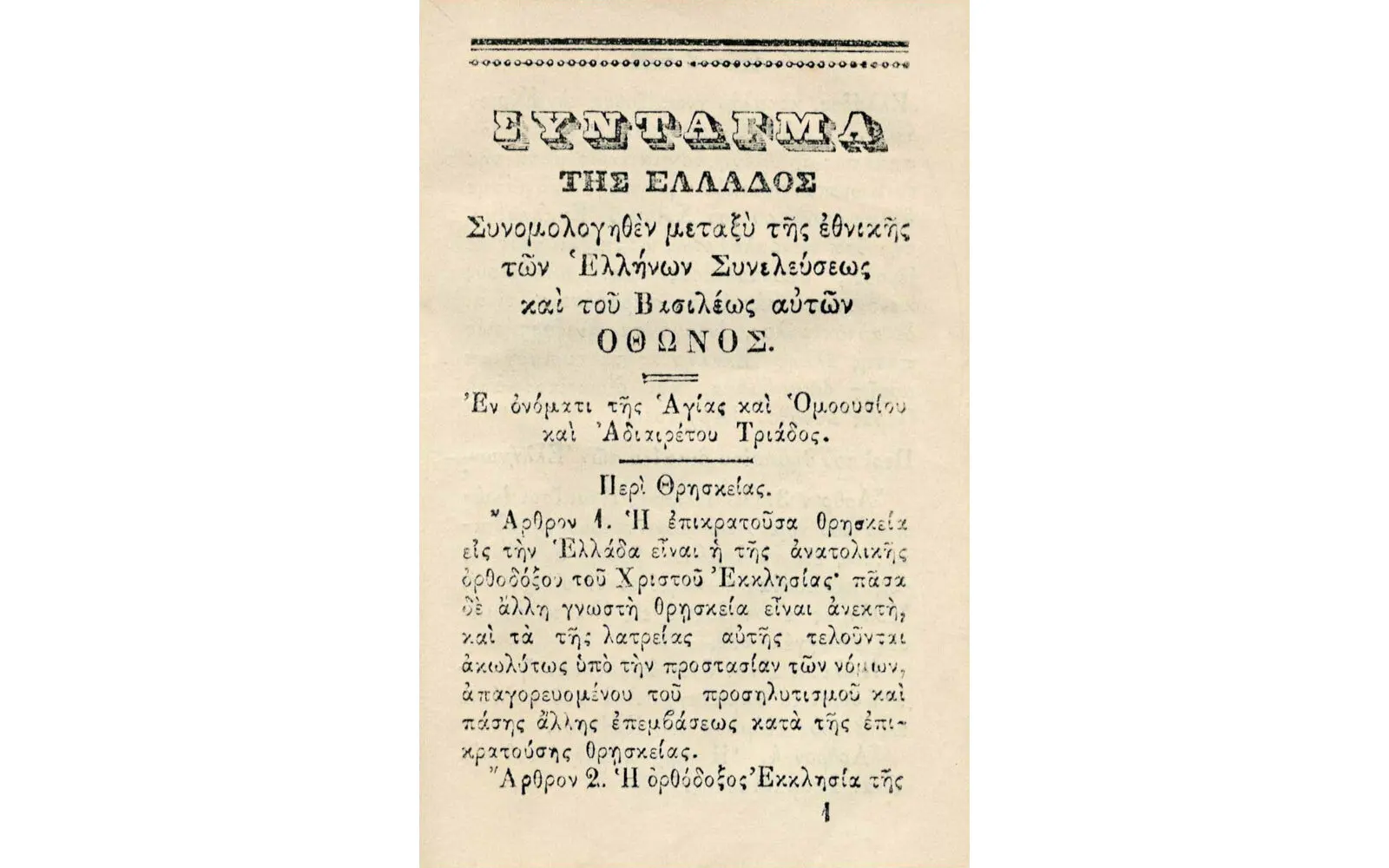
Archive note: This text comes from the old archive of Nomika Epilekta and is preserved with care for historical and informational reading.
Article 1:
1. The form of government of Greece is that of a Presidential Parliamentary Republic.
2. The foundation of the polity is popular sovereignty.
3. All powers derive from the People, exist for the People and the Nation, and are exercised as the Constitution provides.
The proclaimed foundation stone of our once DEMOCRACY has now become an empty letter. A Democracy that made us proud. I remember, at about the age of seven, living in Germany, when a German schoolmate asked me: Are you Greek? And I answered, swelling with pride: Yes, and I am very proud of it. And I was. And I am still proud that I come from the Greeks. That I carry on me, whether they want it or not, the centuries-old Greek history, living in the city from which Democracy sprang and gave enslaved peoples and nations water to drink.
But I am ashamed that today in my country Democracy has been overthrown. In the most brutal and unexpected way, by our own compatriots. As if we are not worthy of having democracy and enjoying its benefits as we move deep into the second decade of the twenty-first century.
Paragraph 1. The form of government of Greece is a Presidential Parliamentary Republic!
Really? Then why do I no longer see it? Just as I am sure that no other sensible and intelligent person sees it either, anyone who is living through the most tragic moments of modern Greek history and has finally stopped fooling himself.
In a strange and at the same time self-evident way, until today we had always managed to borrow a little of our ancestors' glory. And we managed it well because, one way or another, we supported that glory and our famous origin to some extent. Today I feel that we have cut every bond with our glorious past. And this saddens me. And it angers me. And it makes me ashamed. And I do not like being ashamed, especially for the acts and omissions of others. But because I have decided that the time has come for me too to assume my responsibilities, I will no longer hide behind my finger. I feel guilty, because I too am at fault. As we all are. Because we all contributed, either by our acts or by our omissions.
Paragraph 2: The foundation of the polity is popular sovereignty.
We saw that too. Or did we not? Popular sovereignty is what supports the polity. Only no one ever told us, not even us learned in the law who supposedly know these things by heart, what the consequences might be if popular sovereignty does not rise to the occasion and does not support and found the polity for which our ancestors knew exactly what they had to do in order to defend it. And the moment came for us to see in practice what the consequences are. And I do not know about you, but I do not like those consequences at all. My mind and my heart rebel with every cell. I do not like the images; the sensations disturb me. I look for hope to hold on to. It cannot be too late. Even now, something may still be done.
Paragraph 3: All powers derive from the People, exist for the People and the Nation, and are exercised as the Constitution provides.
Irony in all its grandeur. Powers derive from the People. Indeed, since the People distributed powers generously in order later to reap indirectly the positive results of those powers. It did not matter to whom they would give power. Usually to whoever promised the most. Or to whoever promised more convincingly. Or both.
As for the statement that powers exist for the People and the Nation, it is probably the most misunderstood proclamation. Perhaps because no one ever explained to us that the real meaning was not that we should use the powers to settle ourselves and our children comfortably.
In the end, everything is due to a great misunderstanding. We did not interpret the concepts correctly. But they never told us that we had understood it wrongly.
So again it is not our fault. Let us not deceive ourselves anymore. It is our fault. And we will pay. Let us only hope that we will be given from above the opportunity to make amends. Let us hope it is not too late.
Comments
Share your thoughts about this article.
No comments yet. Be the first to comment.
Submit a comment