Archive note: This text comes from the old archive of Nomika Epilekta and is preserved with care for historical and informative reading.
Wherever the researcher turns, he can find historical and scientific information, articles, studies, books and lectures on the national anniversary of March 25, 1821.
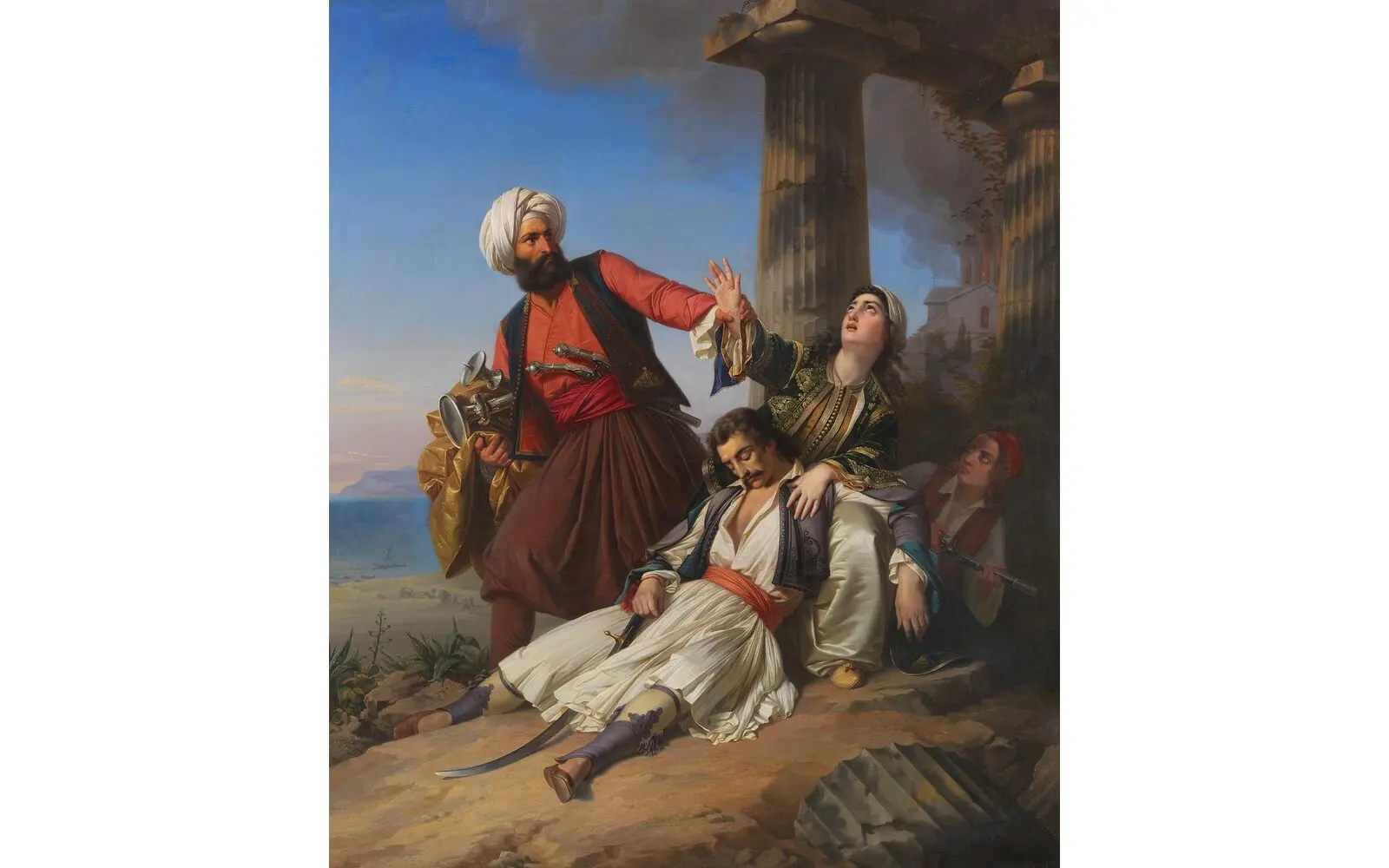
He can discover a multitude of books and paintings referring to the day of the revolution of 1821, which was established as the National Celebration of the Greeks. It is the anniversary of the beginning of the revolutionary struggle, according to a royal decree of Otto issued on 15.03.1838.
The Greek Revolution of 1821 was a genuinely liberating struggle of the enslaved Greeks against the Ottoman Empire. It was the last uprising among smaller-scale liberation efforts that followed the fall of Constantinople.
The revolution was prepared by the legendary “Filiki Etaireia,” supported by the Greek Enlightenment and strengthened by philhellenism, an offshoot of European romanticism.
The revolution spread to most areas where Orthodox Christians with Greek, or Romios, consciousness lived, or where Greek communities existed, from Moldavia and Wallachia and Crete to Cyprus.
It spread across the whole Peloponnese, reached Central Greece, Epirus and Thessaly, and included all of Macedonia and the Aegean islands.
The military forces of the Ottoman Empire, reinforced by the Sultan’s vassals, clashed with the revolutionaries. In the end the latter prevailed thanks to their determination and stubbornness, which were rewarded through treaties. The happy outcome was the creation of the Kingdom of Greece under the protection of the Great Powers of Europe.
Because of the founding of the Greek State, disagreements arose among the European powers which dissolved the “Holy Alliance,” the coalition of the great European powers that had emerged after Napoleon’s defeat and opposed every revolutionary movement.
Gradually, thanks to the struggles of the revolutionaries and the pressure of public opinion in the states of Europe, the Greeks were initially recognized as belligerents by England, which also accepted the naval blockade of Ottoman ports by the revolutionaries in 1823.
Ultimately, the Revolution of 1821 became a major milestone in the history of Hellenism, because it succeeded in creating the Greek state, which appeared on the map among the states of the world after an absence of many centuries.
The lessons from this great national revolution can guide us and help us free ourselves from social decline and economic subjugation, which is expected to last for many years.
Just as subjugation to foreign conquerors is attributed to our enormous mistakes, to our inability to agree, to our weakness in cooperating, to our quarrelsome character and to our other defects, above all selfishness and complete indifference toward our compatriot and the common good, so too the new subjugation of our people is due to the same defects.
Ottoman conquest was preceded by social and economic decline, the tendency to flee from reality, the abandonment of cultivation of the land, indifference to commerce and shipping, the dissolution of the extended family, endless disputes over trifles, even disagreement over what sex angels had, male or female, caused irreconcilable conflicts, and the lack of understanding even about the obvious matters of common life.
Today’s foreign economic occupation was preceded by a corresponding, perhaps even worse, social and economic decline, with the waste of enormous resources on the celebrations and festivals of “democracy,” on false pensions and paid idleness, on flight from economic reality through continual borrowing and the over-indebtedness of the state, on the distribution of money to followers of each party orthodoxy, and on everything else we lived through while remaining inactive.
Instead of struggling with consistency, effectiveness and passion for progress and prosperity, we abandoned agriculture, turned our backs on the traditional maritime professions, gathered in Athens, Thessaloniki, Patras and Heraklion, leaving the mainland and island provinces deserted. Most of us, instead of entering the production of income, products, culture and knowledge, preferred to join party armies in order to acquire consumer goods without effort, largely useless goods, and to accumulate equally effortless wealth, which is now being harvested by successive taxes and endless charges.
Instead of education we acquired party consciences and affiliations. We learned by heart and in confusion which the electoral districts are, how many deputies there are, where and by whom they are elected, how many polling centers each party has, who the local party boss is with whom we will maintain contacts and transactional relations, when the honorary leader’s grandson will become mayor, which woman Varvitsiotis’s son fell in love with, whether Alevras’s nephew washed his hair, where Liapis went on holiday, whether Laliotis fell ill, where Natasa has her holiday house, whether Andreas’s widow received a decent pension and whether she will sell the mansion with the relics of Change, whether Androulakis produced an aphorism, which line Karatzaferis launched, what shirts Tsipras wears and where Papariga’s daughters study.
When the Byzantines, the Romioi, were subjugated to the Ottomans, they fatalistically blamed divine will, adopting the consoling slogan that it was supposedly “God’s will for the City to become Turkish,” and not, of course, that the City fell because of the mistakes of those who were enslaved.
Now that we have been subjugated to international bankers, we have, with similar fatalism, blamed the politicians, especially those of the two largest parties, setting aside our own unforgivable mistakes, defects and choices.
In both cases and in the corresponding eras, on the basis of the principle, often verified, that “history repeats itself,” we see the repetition of mistakes and failures that always end in subjugation, poverty and misery.
On the occasion of the National Anniversary of March 25, we have the opportunity to draw lessons, examples and knowledge from the struggles and, above all, from the sufferings of the fighters of 1821, charting a modern and steady course, without failures and with fewer mistakes, toward a new Rebirth which, beyond economic recovery, will revive society, drive away the Balkan syndrome of misery, and open our bleary eyes to the horizons of the world.
We need a new Rebirth of knowledge, reason, work, concord, and cooperation with other peoples, escaping the decline of our small state, which is not the center of the earth but can become what Kostis Palamas’s poem says of Athens: “Greece, a diamond stone in the ring of the earth.” May it be so, as people once said.
E. Papadakis



Comments
Share your thoughts about this article.
No comments yet. Be the first to comment.
Submit a comment