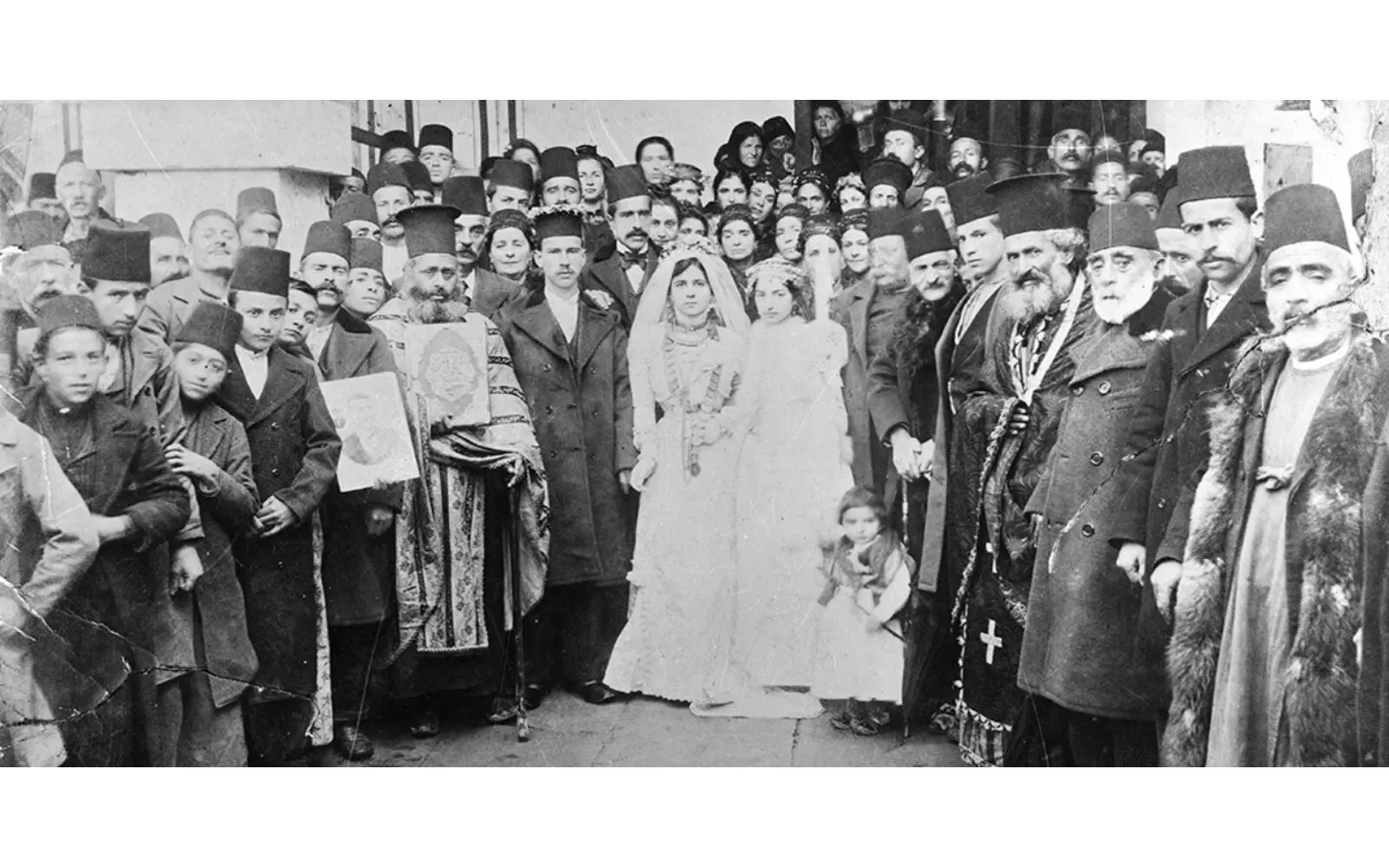
Archive note: The text comes from the old file of the Legal Selectmen and is carefully preserved for historical and informative reading.
In the previous articles it was argued that the modern (permanent, exclusive and lasting) relationship of a man with a woman (and a woman with a man) is based on freedom in all aspects of common life. The word "spouses" is not literal. The word "companions" or something better that emphasizes companionship (equality - parity), without which there is no modern marriage or lasting love bond (ordo amoris - order of love) is appropriate. Without an equal relationship of sincere feelings and genuine love, any "marriage" (sacrament, ceremony, cohabitation) has no value. Modern marriage makes life qualitatively better and those who accept it happy. With dreams, with prospects of progress, personal completion and fullness. Under the necessary condition that it does not hinder but rather facilitates and strengthens the formation of the personality of those romantically connected, the education, the profession, the abilities and the other elements that constitute and promote the value of every human being regardless of gender.The words "couple" and "couple" are outdated. No more concepts are tolerated. They don't quantify. They refer to coupling, yoke and captive or unfree – bound. Of course, getting married has always had (for the majority) the meaning of evolution - progress, of upward progress, of climbing to something better (as the phrase goes: "To climb the steps of the church"), i.e. the personal and social upgrading of the man and the woman. They stopped being alone and got a partner. The "other", who, in many cases, may have loved and wanted to be with him as a mate (a better word than couple - couple), because he had been chosen, the man by the woman and the woman by the man and not by the elders, usually by their parents. They were sure that they matched and that life together would be better compared to the previous state of "loneliness". This certainty also exists in modern brides-to-be. Therefore, marriage gathers the esteem of the majority. Those who oppose the institution of marriage are a minority, usually divorced or by conviction placed in favor of absolute independence and against any commitment. Without freedom, even the strongest love relationship is - mathematically speaking - transitory, fragile - mortal and · (a) either it will end, sooner or later, in separation (with or without divorce, which is a simple paper and nothing more), peaceful or episodic, so that the oppression ceases, (b) either, instead of a love connection, it will be transformed into a theatrical performance, into a real theatre with vain actors both of them, who will play the roles of the "married", each maintaining, as a rule, a "double life": The socially visible and the hidden, with the palpitations and anxiety of the apocalypse ("him/her caught in the act").The phrase “bond of marriage” is rejected, because marriage is no longer a bond. It is a new better, free, qualitatively improved, honest, equal, more comfortable life of two heterosexual, the man and the woman, who are not connected by a bond but with their consent they cooperate in the context of a common life, because they have chosen to live together believing that this new situation satisfies them and is qualitatively better than the previous one. It makes their existence have a purpose: To enjoy each other, onetogether with the other. Let one seek and enjoy the happiness and joy of the other, which he feels as his own happiness and joy. It is not an idealization nor a utopia. This is a whole new type of marriage that lasts and makes heterosexual couples truly happy. This marriage is distinguished from transitory love relationships, love affairs, frivolous contacts and immature connections, because it has the element of duration, permanence, exclusivity, authenticity and absolutely rejects other relationships outside of it (of the man with another or others and of the woman with another or others) as their free choice and not as an imposition or prohibition. In genuine love life other love communications are automatically excluded, without effort or prohibitions. They don't make sense anymore. Man and woman have joined together and feel completeness. They do not seek another or other relationships, which they immediately reject. Modern marriage is characterized as a genuine love relationship to exclude any relationship that includes the element of material calculation and any calculation. Which is not based on mutual feelings and attraction. This ungenuine relationship will have the same preordained ending: It won't last. It will dissolve. It will not create happiness for the man and the woman, and certainly both will suffer, more or less, until they disengage, get rid of each other for good with relief.Also, the word "androgynous" is not literal, because it refers to something non-existent - a construction of fantasy. As if it were a third party, beyond and outside of those connected with their free and unaffected decision (their "consent"). As if the impossible has become a reality: "The two are in one flesh", because, in its human dimensions, there cannot be such an absolute connection, which is realized only on a transcendental - religious level or in our dreams. The two are inextricably united only according to ecclesiastical views, and absolute union is perceived theologically and requires corresponding religious and theological analysis to be approached. Absolute identification does not bring happiness either because it is an extremity. Cohabitation and marriage do not presuppose absolute situations and complete identification. They require cooperation, collaboration and mutual support in every circumstance of family and social life, but not absolute identification, because if there is any such identification, the dialogue between the woman and the man will be abolished and gradually at least boredom will prevail, because they will no longer be able to talk together, to clash creatively in order to arrive at the best result, to improve each other and to they associate with each other. Your partner cannot be someone with whom you identify in everything or almost everything. Maybe he is a follower, a follower, an admirer, a slave but not a partner, a match, your own person with whom you are happy to communicate every day and every moment without being "bored to death", with the thought: "He again? I'm bored" and similar and familiar things. Constructions and creatures of the imagination, of our mind, are the concepts: "Marriage", "husband", "family" and "partner" together with all related words - concepts - phrases, when they do not correspond to true situations of life (if they are not based on empirical reality) and are not a product of free choice and consent.For example, a “companion” (or “husband”) is not one with whom a woman believes she is associated with the ceremony of marriage, religious ceremony, or political process (and vice versa), but one who behaves in such a way that he can be labeled a “companion” (or “husband”) based on his specific companion (or conjugal) behavior even without a wedding ceremony. Analogous: Dimitris and Anna's child is not Thanasis, because he seems to be related biologically (by "blood bond", DNA and chromosomes) to Dimitris and Anna, but he (Thanasis, in this case) who externalizes the behavior of a child, bestowing original respect on his parents (the Dimitris and Anna), communicating with them by his own decision, without coercion, having time and place communication with them, by his free choice, exchanging information, participating in family events, joys and sorrows, and showing by his behavior that he recognizes Dimitris and Anna as his father and mother, respectively. The same applies to Dimitris, who, with his behavior, claims and acquires the status of a father, as well as for Anna, who, with her own behavior, in every situation, shows Thanasis that she is his mother. nature does not recognize any of the above properties. It does not recognize all the others, to which the human language and intellect gave specific names to each one. These are purely social, i.e. imaginary - virtual, and not about physical and real properties (they are properties that cannot be proven empirically, with the senses). Nature does not recognize children, doctors, engineers, grocers, traffic wardens, judges, airmen, brothers, mothers, fathers, priests, officers, drivers, captains and anyone else one can think of and add. Each of these qualities, which are creatures of our imagination (constructions of our intellect), in order to acquire existence and not remain in the realm of non-existence and myth, must be supported by specific behaviour, which can be ascertained at any moment.Excluded are the instincts which nature recognizes and man limits. These are empirically established when the human pretense, the so-called culture, which hides them or channels them in other directions with similar acquired and pretentious behaviors, which are almost always taught by the older and experienced to the younger and inexperienced, is not effective. Instincts include, for example, the maternal filter, maternal and paternal affection, the feeling of pity and compassion, the instinct of self-preservation and whatever else has been established by observation and science. In the above examples, if Dimitris has (and shows – externalises) fatherly behaviors (interested in the minor or adult child), instructing, nurturing, framing, supporting morally and materially, teaching, punishing, communicating without being satisfied with the father's instinct (which can be subdued or rudimentary or absent in some extreme cases) he is real father, according to his behaviors that are "fatherly". Similarly, Anna, with her behaviors (beyond the maternal instinct or filter that is not controlled), constantly claims the maternal status, which is not acquired with the child's birth alone, but is conquered over time, if she surrounds the child while he is a minor, nurtures him, takes an interest in him, educates him appropriately, admonishes him, cares and communicates, according to her behaviors that are "maternal". The physical-biological process alone (pregnancy, gestation, the birth of the child, nursing the infant, natural growth, the rest of the normal) and the social process alone (acquaintance, the creation of a romantic relationship, the engagement, the marriage ceremony, registration in the registry office, naming and the like, no matter how faithfully observed) do not give life to the virtual - social properties mentioned above as well as all the others. Existence and life acquire these giving social properties only if they correspond essentially to what they characterize. Each property is confirmed with the required behaviors, in practice. For example: Child's, mother's, father's, spouse's, doctor's, teacher's and so on.Are these observations real, do they have substance, or do they seem unreal and meaningless? It has always been true what is pointed out on the occasion of the research on the state of marriage as an institution that has no relation to the marriage of past generations. People always believe in the existence of non-existent things. And if you believe something passionately, you create it from nothing [“it is so, if you believe so”]. They consider as immaterial what the mind has made and, because of the attachment to the constructions of the imagination, to virtual situations, they live in a virtual, that is, in a false, situation (in a virtual reality) that they think is real life. The result was (and still is in many cases) the adaptation of their behavior to the virtual "reality" and the corresponding action guided by the fake and virtual environment which always results in inappropriate (i.e. negative) results, guiding (manipulating) real behaviors and human actions. If, in other words, Dimitris believes that Evangelia is his "wife" because, after meeting and having a love affair, his marriage with her was consummated (and he does not give the necessary importance to her behavior, but is content with the typical features), he will think that he has a husband (companion), a "his" person, on whom he can rely and trust. In fact, he is likely to be living with the most inveterate enemy and adversary, wreaking havoc on all levels (financial, social, professional, familial, emotional, and more). There are many social and practical examples: The man-husband who is connected to a woman because they both took part in the wedding ceremony, gathers all the necessary information about the financial situation of his wife, learns all the secrets connected with her profession and, equipped with this knowledge, succeeds in appropriating her property, infiltrating her professional environment and finally leaving her. reaping all the benefits he managed to extract based on the woman's belief that he was her own partner, her own person, because of the marriage.Thalia, who lives with Giannis in the virtual environment and the false reality (made by marriage as a ceremony and not as a tangible and empirically proven substance) devises a plan to get rid of Giannis, who has already adapted his life to what he believes to be true and not to what is happening: She convinces Giannis to register as members in the casino. She tells him that she likes them going there to have fun gambling. Giannis satisfies the desire of the woman he considers his partner and issues an entry card. Thalia pretends to go to the bathroom, already has an escape plan prepared, and leaves the casino. She heads to the matrimonial home, collects her minor children along with the furniture and household goods and, with the help of her lover, moves into another house. When a restless Yannis returns to his house, maddened by anxiety over the fate of his wife, he finds on the only table left in the empty house a petition - a petition addressed to the court. In this application, Thalia has written that her husband is a pathological gambler. He abandons the marital home to satisfy his passion and spends the night in the casino. He does not financially and morally support his family and, for this reason, she was forced to leave him. Result: John was left alone. He was estranged from his two daughters. His profession was destroyed. He was obliged by the courts to pay perversions to his "wife" and to his two children and ended up living alone in a shack, without property and without comfort, in his old age.How did Elias treat his wife Irene, when he found out that she wanted to leave, dissolving their meaningless marriage: Irene, with whom Elias had lived for several decades (in the context of the virtual reality that is created when importance is given to the marriage ceremony as if it were something supernatural that changes life), could not take it anymore and wanted to escape from years of oppression and from the abuses of her husband. Elias, using what he knew about her successful freelance business, hatched a plan to destroy her and enrich himself. He removed all the money from the woman's business account, which was at his request public, began to defame her and pass her off as his wife, who was an example of loyalty and devotion to him (due to the consummation of the marriage and the virtual reality it created), and recruited a sworn lawyer with whom he worked to destroy Irene. The lawyer (a family "friend", based on the criteria of "virtual reality") convinced the victim wife that she should remain in the marital home because it was allegedly required by law until a divorce was granted. Until then, Elias succeeded in gradually seizing, with the help of the "lawyer", all of Irini's real estate, all of her savings and all of the things that she had acquired through her decades of hard work. In the end, Ilias became rich, Irene lost her property, took over the upbringing of her adult children and, beyond that, became aservant of the children because she believed she had an obligation to take care of them until the end of her life, directing her actions because of the virtual reality she was experiencing. By consummating the marriage, the man thought he had acquired a devoted and faithful wife of his own. The woman believed the same in terms of devotion and loyalty, except for the property element, because she herself was the property of her husband. The result was that for the man and the woman the acquired (essentially virtual) property of the spouses covered their every need, because they had the belief that the marriage had an independent existence and changed them into something else from the moment it was performed.They believed that they had mutated into "one flesh", into one body through the ceremony-sacrament of marriage, and this belief they reproduced on every occasion. It did not matter if the woman (and often the man) had not been asked about her future husband, who had been chosen and decided by others. It didn't matter if the man and the woman did not have feelings for each other, or even simple sympathy (the advice of experienced elders was valid: "It doesn't matter. Little by little you will get used to him/her"). It didn't matter if one loathed the other, hated him, or couldn't stand him. What mattered was the performance of the marriage which covered all the objections, shortcomings, annoying defects and disharmony. Marriage was so strong as a social institution of universal acceptance that anyone who sought its solution immediately turned into a violator of social institutions (of divine or natural law). He was considered immune. After all, any attempt or agreement that helped dissolve the marriage was illegal and void (legally non-existent and immoral) until the 80s and a little beyond that. Under this burden marriage crushed the spouses (to this day we talk about the burdens of marriage with reference to the spouses' living expenses)! Above all, the woman was crushed for whom many still argue that the legislation provided her with privileges, compared to the man: In the right to alimony at the expense of the man and for the custody of the children which as a rule was obtained by court decisions.However, these are not privileges, but concessions from benevolence. The woman as a person with reduced rights at all levels (a situation that is still not with the same intensity of the past especially in the remuneration of her work), who did not practice a profession and had the status of "housewife", declaring as her occupation "domestic", with the few exceptions of some women who, with their personal and solitary struggles, had escaped (and emerged socially and professionally), claimed the elementary right to the survival of herself and her minor child or children, when, despite her efforts, oppressions and youthful patience, she was abandoned by her husband (unprotected and unemployed without means of life, "on the five roads"). This right was recognized by the courts which assigned her the custody of children, with the exception of boys who, after the age of ten, were handed over to the father, who was considered better able to raise men. Much has been written about this situation and the struggle of women to obtain basic rights. That is, equal rights as equal human beings. For women a few decades ago, especially in the 50s - 60s (up to the 80s), the state did not recognize fundamental political rights. It was only in the 50s that he acquired the right to vote, the right to vote and be elected, which was an exclusive male privilege. Until the "radical" modification of the family law of the Civil Code, a woman did not have the right to trade without her husband's permission, and her testimony had no greater value than the testimony of a child or a lunatic. Also, a lot has been written about men who, as a rule, lost any right to custody of their children, as a result of which they are estranged from them, in the case of dissolution of marriage and separation, with or without the issuance of divorce. These situations should definitely belong to the past, but they are mentioned to make it obvious why modern marriage has nothing to do with what was true in the past, with the exception of those who still stubbornly reproduce the past by ruminating on what modern life pushes to the sidelines.In the past, when marriage as a relationship and bond of love was effectively dissolved, it was still formally preserved on paper and in the registry office for many years and often decades or forever. From this dead marriage, both "estranged" spouses derived rights, one against the other, and maintained corresponding obligations and duties. This is pointed out in order to emphasize the great social importance of marriage as an act regulating the law (legal action sui generis: idiosyncratic) and its effect on the life of the citizen. Along with the deceased, there were unofficial and illegal marriages, from which children were born who, through no fault of their own and without being asked, acquired the social stigma of illegitimate. Eventually, the law abolished the word exogamy and adopted the phrase: "Children without the marriage of their parents". No Giannis, Giannakis. However, such a stigma is no longer recognized by society, which, despite its sluggishness, has made significant progress in at least this area. The standard maintenance of the "marriage" does not matter. That is, the existence of a note in the books or in the electronic records of the registry office that mentions it. Modern men and women deal with theessence of the relationship. They require and have, as a rule, a relationship of true communication, a relationship of substance. They don't settle for types. Excluded are the cases of the intentional preservation of the registered "marriage" for reasons of financial or similar interest that are not of interest to the present analysis. Many women, dragged even today by the great pressure of their so-called paternal family and their wider social environment, compromise, they do not choose but accept a pre-selected husband, with a consul, just to get married and establish themselves in front of society as well as themselves. To become ladies and to be "rehabilitated", according to the "traditional" concepts that still exist. The woman who retreats, accepting the outdated notions, suffers because such a compromised "marriage", without companionship, consent and freedom, is torture with the deprivation of freedom and the acceptance of another person, the husband, with whom she does not fit. That's why she didn't choose him, but they chose him for her.With the birth of a child or children, the situation of the woman - husband worsens. She is emotionally pressured to remain compliant, believing that she is protecting the child or children by being patient. Giving in. Making constant compromises with repressions. Reaching many times the extreme limits of her endurance. Its guide is the mistaken belief that children grow up better within the framework of a family. Even if this "family", i.e. herself as a servant, exists thanks to compromises, patience, suppression of every free breath and retreats. This is a fake (virtual) family that is only confirmed by the registry office papers and the "certificates" issued by it. Similarly, many men who are pressured by their mother to "household" suffer: To find a woman - usually a victim, willing to undertake service and replace her in the role of therapeinida (the willing servant) which the mother performed voluntarily, in exchange for "rehabilitation", as it has been understood for several millennia. The case of the titular mother who is interested and acts for the sake of the first-born and, indeed, the only son who excels, is incurable. He is not compared to any other man, nor to the husband, who, by the birth of the child, fulfilled his mission. The only son undoubtedly belongs to the exclusive responsibility of the mother and not the wife, because there is no mention of a partner and modern concepts. The only son dogmatically always belongs to his mother who guides him to her old age, who only when approached allows the man to mature. That is probably why most men are slow to mature, unlike women who know what they want even before they reach adulthood.The mother's involvement in marriage matters is beyond the scope of this analysis. It also avoids the involvement of parents and third parties. These are issues that require separate development. However, it is emphasized that there is no room for any third party in the union of romantic partners, man and woman. And all without exception, except for the two romantically linked, are third parties. The position of third parties is outside of their intimate connection, which is mentally formed by their feelings and love attraction which is mental-spiritual and, on a second level, physical. Spiritual and physical attraction are preserved in the genuine relationships of the modern love affair or the modern marriage of equality and consent regardless of time which does not wear them down but strengthens them with granite durability. Marriage in modern culturally advanced societies is considered a fundamental social institution. But it does not really exist unless it is accompanied by the companionship of man and woman as described above. Still the modern marriage of companionship, consensus and equality or parity relies on honesty to last harmoniously without time limit. Honesty has nothing to do with declarations, revelations, confessions, promises, consistency and anything else related. It has to do with the recognition of the strengths and weaknesses, the abilities and shortcomings of the man towards the woman and the woman towards the man. In other words, male and female are no longer recognized as having strictly predetermined roles, duties and responsibilities as they used to be, when there were these separate roles which they had to play by fulfilling respective prescribed duties, which were the duties of the woman, the most and the inferior, and the duties of the man, the superior and the noblest. As a rule, only the man was educated and studied and he had the right to dowry, which today causes disgust as an institution, habit and custom. But in practice, informally, it is welcome.The woman was meant to dominate in her home, having the so-called key kingdom, and this typically also for comfort. Its sovereignty was valid in the absence of the man who, with his presence in the conjugal residence, immediately took over the administration ("chief present, all authority ceases"), imposing his absolute and legally guaranteed will without contradiction (objection). The man's will was limited only when it became demonstrably extreme and became a misdemeanor as it manifested itself in brutalities, handiwork and other extremes. However, there was talk of the "non-proof of conjugal misdemeanors", that is, the impossibility of proving the offenses committed mainly by the husband inside the conjugal residence, without the presence of witnesses. Thus the brutal man-husband escaped the condemnation that fell on the weak female shoulders with the general disapproval of the woman-husband in almost every case. Especially in the case of the dissolution of the marriage, society accepted it as her weakness to "keep her husband". Male misbehavior that remained unarmed rarely received similar adverse treatment. In modern marriage, a kind of equality prevails, with the woman sharing the household chores with her partner just as she also shares the costs of maintaining the common residence and their living. This happens because of the right and participation of the woman in the production process or, more correctly, because the woman also works, sometimes much more and more efficiently than her husband. That is why the woman demanded and then succeeded in getting rid of half or part of the housework and care that was her only occupation. With the perspective of connecting a woman's life with a man's life in the relationship called marriage, on the one hand, spontaneity, romantic attraction or the so-called "chemistry" play a key role, but, on the other hand, there are various calculations that weaken spontaneity and romantic attraction by neutralizing even the most sincere, deep and powerful feelings.Perhaps most women and the majority of men do not enter into a modern marriage but prefer and favor the "traditional" marriage of convenience and convenience. That is why the experts observe an increase in "divorces" and the dissolution of more "marriages" than in the past. The increase in divorce is due to the ease with which marriages dissolve. Of course, instead of stating that the man and the woman were freed from a coercive relationship that was regulated by official documents and not by their will, we say that "divorced" or "the marriage was dissolved". In the place of the persons, the man and the woman, were put the constructed concepts of "marriage" and "family", which are interesting to exist virtually regardless of whether the man and the woman suffer and wear out every day. In the past, due to the principle that "marriage" was indissoluble and divorces were the exception (after long and hard legal disputes), the man and the woman remained together necessarily even if their marriage had no content and their communication had been interrupted. The forced cohabitation of spouses, which was identified with the concept of marriage, often caused unresolved problems and complexes due to the deprivation of freedom of those who had to cohabitate, due to legal coercion and social imposition (note that the abandonment of the marital residence is considered as an alleged serious grounds for divorce, because it fundamentally undermines the relationship of the spouses). Their lives became unlivable and the conflicts reached extremes, physical violence, injuries and, sometimes, murders. Such situations still exist today, with the difference that the disentanglement is easy and the release of a fixer without complications. It is enough for the man and the woman to realize that forced cohabitation and coexistence are not beneficial, when the elements that unite two heterosexuals in a common life have been lost. If the mutual love, appreciation, respect, attraction and excitement, which are always present at the beginning of the relationship, are lost, any emotional or other compulsion to attend the performances of the so-called "family" theater is meaningless.Neither relatives, nor adult or minor children, nor anyone else is allowed to force and hold together those who do not have anything in common and capable of connecting them, and in the place of love, hatred, boredom, routine, indifference and other negative feelings show that the moment of irrevocable removal has arrived. And moving away does not mean breaking up, because that has already happened before the final separation, which is formal. It means reclaiming and typical of untamed freedom. Modern marriage is almost always decided by the woman and the man consents and, as a rule, follows sometimes willingly and sometimes reluctantly, because of the prejudices that still influence together with the influences and reactions of his environment, family and wider. The man decides to marry only when the woman with whom he is emotionally attached declares that she will leave him. Then the man becomes active and proposes marriage so as not to lose his mistress. The age difference plays an important role, unlike in the past, with the marriages of men who were one or more decades older than their female spouses, because the mindsets differ between the significantly older and younger ones and it is not possible or easy to get along a middle-aged man with a young woman and vice versa. In the past it was possible for a 14- to 17-year-old woman to marry an adult or middle-aged man. Today such a marriage is unthinkable and an anomaly. In modern marriage the ages of the man and the woman are proportional and the age difference tends to zero. Thus, it is possible to understand each other and their harmonious coexistence under the conditions mentioned above. Age differences of up to a decade or so do not create problems. Larger differences soon result in a breakup, usually episodic, due to the reaction of the man mainly who does not want to admit that the younger woman is leaving him. His ego and self-confidence are affected because of his immaturity and character weaknesses.When a man connects with a woman, in the context of marriage or another similar relationship, the duration, the harmony of the relationship and the existence of a smooth common life and an organized family, with or without having children, depends on whether the man or the woman has the first say and "management". If the woman directs, directly or indirectly, and decides on serious matters, the family is preserved and happy. If the man is in charge, the family usually breaks up into pieces, and if the man and the woman manage together, conflicts and constant tensions are created that often end up in general dissolution. The above findings are safe and their truth can be checked from our experience starting from the family environment of each one, with main reference to the so-called "paternal family". It will be found that always, directly or indirectly, the mother decided wisely and the father-husband always followed, in all serious as well as the simplest matters. Therefore, the man, in the modern marriage and in every similar relationship, must recognize the female abilities, the maturity of the woman, which was wrongly characterized as supposedly "female cunning", her skills and endurance and adapt his behavior accordingly, cooperating with compliance with the female instructions (of the woman - partner) in most areas of modern life. He still has to recognize that the man, even at a mature age, can remain immature and frivolous, if he does not cooperate with his partner in life and does not admit to her superiority in many, perhaps most, ways, with the thought that only the woman can become a direct and not indirect accomplice in the work of Creation with pregnancy (this miracle of life) and only the woman is able, as a rule, to assume the roles of both parents, in contrast to the man, who, exceptionally, in rare cases, when he has been guided by a virtuous mother, can replace the mother and single-handedly support the child or children until they grow up.Without egos, with wisdom, knowledge and prudence, the man and the woman in modern marriage connect, cooperate, strive and create to make their personal life better, bright, heavenly with a perspective of eternity. E. Papadakis


Comments
Share your thoughts about this article.
No comments yet. Be the first to comment.
Submit a comment