Archive note: This text comes from the old archive of Nomika Epilekta and is preserved with care for historical and informational reading.
A monument may be defined as any product of human activity on earth that is charged with memories. A monument promotes human memory and forms the connecting link between yesterday and today. It bears witness to another era and shapes the particular identity of a place. The need for the conservation and safeguarding of monuments from decay and destruction caused by environmental factors is permanent.
Stone is one of the materials most widely used for the construction of buildings and monuments in antiquity, especially since limestone is abundant in Greece. Mortars, metal clamps and other materials were often used to connect and secure masonry; under the influence of the environment they deteriorate and change. Metal clamps oxidize, expand and exert stress on structural materials until cracking or fracture occurs.
Water, in its various forms, is a major agent of deterioration for monuments. It easily penetrates cracks in stone and, through capillary rise, soaks it in depth while carrying components from the soil, such as salts. In dry periods the water evaporates and the salts crystallize, causing corrosion and damage to ceramics, wall paintings and stones. This phenomenon of salt crystallization is common in monuments located near the sea. Seawater contains salts and therefore affects monument materials through the crystallization of soluble salts, especially in porous materials such as ceramics and stone. When the temperature falls and water turns into ice, strong pressures are created that may lead to fracture.
Another agent of deterioration is fluctuation in relative humidity. Relative humidity above 70% favors the growth of microorganisms and mold on hygroscopic materials such as paper, fabric, wood and others. Conversely, a decrease in humidity levels causes shrinkage and even destruction of these materials. Continuous changes in humidity weaken the materials that make up works of art and often cause irreversible damage or total loss. For this reason the level of relative humidity should remain stable, ideally around 45%.
The biological factor is another cause of deterioration in monuments and museum objects. The acidic character of animal and plant secretions attacks stone and organic materials such as paper, wood, fabric and leather, as does the development of plant-origin colonies, lichens, microorganisms, bacilli and bacteria.
Light, in the visible, infrared and especially ultraviolet spectrum, has destructive effects on the pigments of works of art. Many colors fade, discolor and weaken; direct exposure to abundant sunlight and intense artificial lighting should therefore be avoided. Ultraviolet radiation has negligible effects on inorganic materials such as clay, glass, metal and stone, but high-intensity lighting should still be avoided because it raises the temperature of the space and reduces the level of humidity. Clay and glass can withstand illumination up to 300 lux, while metal and stone can withstand up to 500 lux. Organic materials, however, such as wood, leather, paper, fabric, paintings on wood or canvas, are highly sensitive to ultraviolet radiation, with a maximum permitted limit of 150 lux. To avoid photochemical corrosion in museum spaces, UV screens and UV absorbers are used, while camera flashes and television camera lighting should be avoided.
Continuous temperature rises and falls cause expansion and contraction in materials, resulting in cracks. These changes occur mainly in stone monuments exposed to sun during the day and cooling at night. Rocks are poor conductors of heat, so their exterior heats more than their interior; when this temperature difference is frequent and abrupt, it causes flaking and breakage in a stone monument. A sudden storm, for example, can abruptly lower the temperature of stone that has been heated by the sun, causing cracks and scaling. Temperature combined with humidity has a significant effect on paintings on canvas, causing cracks in the preparation layer and flaking in the paint layer. The average temperature in a museum space should be kept around 21 degrees C and controlled by central air-conditioning systems. The number of visitors affects temperature and humidity; according to specifications, the ideal visitor density is 3 to 5 people per square meter.
An important parameter that must be monitored in exhibition spaces and monument areas is the noise level, which is a significant factor for the safety of objects. In cases of high frequencies from a sound source, the materials of museum objects or the monument may enter resonance and absorb great energy, which can cause serious damage or even destruction. Harmful sound sources may include heavy traffic, an airport near museums and monuments, and construction works. The permissible sound limit in such spaces is 35 to 75 dB.
Industrial air pollution is also an important parameter in the deterioration of monuments, since it contributes to increased concentrations of sulfur dioxide, nitrogen oxides and suspended particles, causing serious damage to monument construction materials such as stone, mortars and metals. Atmospheric pollutants are usually gaseous, or solid in the form of particles. Pollutants include various gases, dusts, sand, clays, metal oxides, gypsum, cement and smoke from incomplete combustion of carbonaceous substances. Winds keep solid particles suspended and carry them as dust or smoke. Larger particles create pits on the surfaces of monuments, while smaller ones adhere and form deposits, black from soot and red from iron oxides. These settle on monument surfaces, causing corrosion in stones, metals, mortars and wall paintings, while reducing their aesthetic value.
In the atmosphere of industrial areas and large cities, as noted, concentrations of carbon dioxide, sulfur dioxide and trioxide and nitrogen oxides are increased. These gases dissolve in rain water and turn into acids, producing the familiar phenomenon of acid rain. The effects of acid attack are visible on sculptures exposed to rain, especially on projections, where facial features are visibly changed. Characteristic examples of acid attack exist in Athens and Rome, where the acidity of rainfall has damaged major monuments such as the Acropolis and the Colosseum. The surfaces of sculptures that do not come into contact with rainwater are converted into gypsum, a process known as gypsification.
Rain water also converts carbon dioxide into acid, acts on marble and dissolves the calcite of monuments. After the rain, once the water evaporates, calcite forms again, leaving the marble surface with a sugared appearance; this phenomenon is called sugaring of marble. The result of this action on monuments is a reduction in their dimensions by one to two centimeters over a period of 2,400 years. Sulfur dioxide causes corresponding effects on marbles and limestone rocks.
Nitrogen oxides, also found in high concentrations in a polluted atmosphere, react with the limestone material of rocks, resulting in dissolution of the material and loss of sculptural details. To avoid these phenomena, monuments should be sheltered where possible.
In addition to stone, other materials in monuments and museum objects are corroded by atmospheric pollutants. Metals oxidize, resulting in loss of mass. Iron corrodes more than any other metal. Copper develops successive layers of corrosion with different colors: red, blue and green. Silver is significantly affected by hydrogen sulfide, especially in high-humidity environments.
Textiles exposed to light and kept in a polluted environment show a high rate of corrosion and decay. The main effect of gaseous pollutants on textiles is the breaking of the weave due to loss of elasticity, along with discoloration. Sulfur dioxide affects leather and paper, causing serious damage. Hydrogen sulfide also interacts with lead contained in certain pigments and blackens them. Book pages show edge discoloration and brittleness. Animal fibers found in wool, silk, leather and parchment are significantly corroded by atmospheric pollution. Leather is corroded by the presence of sulfur dioxide and turns into powder. Similar damage occurs in objects made of wool, silk and papyrus.
Sulfur dioxide also acts directly on many pigments, especially when they are found in wall paintings directly exposed to polluted environments because they have no varnish or other protection. In addition, the mortars of wall paintings that contain calcium carbonate are also corroded.
Atmospheric pollution also affects glass objects through the presence of sulfur dioxide and nitrogen oxide.
For the protection of monuments and museum objects from air pollution, continuous control of the museum atmosphere is required, with air renewal and installation of activated-carbon filters. A large number of visitors should also be avoided so that the level of humidity and the concentration of carbon dioxide in the atmosphere do not rise. For monuments in outdoor spaces, exposed to air pollution, airtight transparent cases with an inert atmosphere are required, as in the case of the bronze statues of Piraeus, which are kept under special nitrogen conditions and protected from humidity and exhaust fumes. Very often, sculptures and other objects that can be moved are placed in museum spaces and replaced by copies, as happened with the Caryatids, which have already been moved to the new Acropolis Museum for protection, with faithful copies installed in their place.
The last kind of environmental attack is human action itself. A monument may be functional, used and visited by many people, and this certainly causes wear. There are also people who are indifferent to the historical, aesthetic or archaeological value of exhibits and monuments. The result is names and slogans carved or sprayed on them. Many cultural monuments have also been destroyed for reasons of religious fanaticism, while others have been wounded by antiquities trafficking, as seen in headless statues whose weight prevented thieves from stealing them whole. Unfortunately fencing is not always possible, nor is guarding. Only museums and sheltered archaeological sites can be fully controlled. There, exhibits are protected from every environmental factor of deterioration, and storage conditions are controlled.
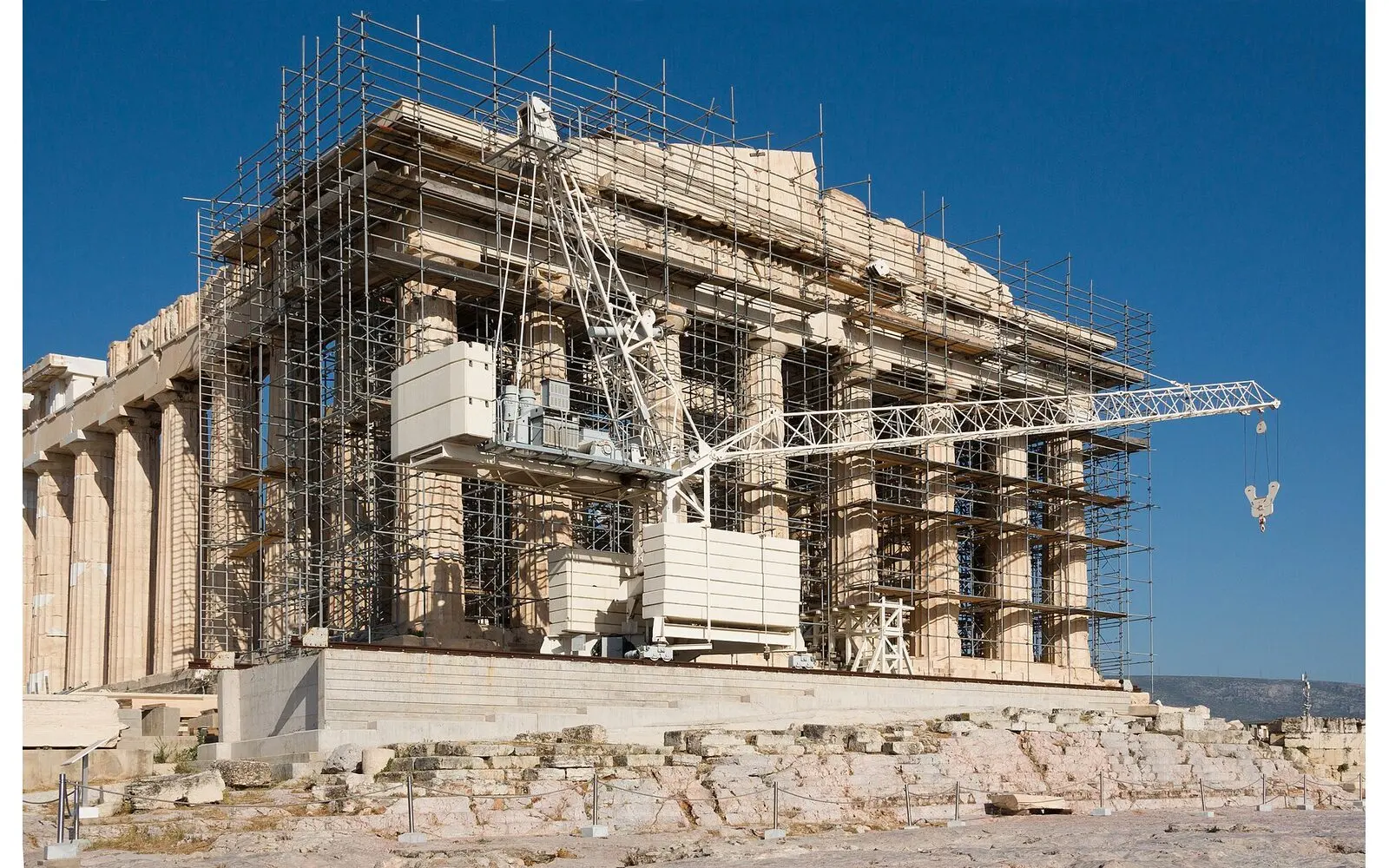
In Athens, measurements show that concentrations of dangerous gases in the atmosphere are very high. The need for immediate measures is urgent, so that the corrosion of monuments can be limited and our national heritage safeguarded. The Parthenon has stood proudly on the rock of the Acropolis for more than 2,000 years. It survived earthquakes, bombardments, conquerors and weather conditions, yet the greatest damage it has suffered has occurred in recent decades because of the burdened atmosphere.
Climate change, which scientists expect in the coming years, is likely to directly threaten priceless archaeological treasures. Rising sea levels and more frequent extreme weather events will directly affect monuments, such as those of Venice, while changes in humidity and temperature conditions will indirectly have severe effects on monuments and historic sites. Protecting monuments is not only a necessity but a national duty and a sign of respect for our history. Effective protection of a monument or archaeological site exposed to weather conditions is not always easy; the dilemmas are many. The protection of these sites may require structures that change both the natural environment and the historicity and aesthetic value of the place.
Bibliography
Lampropoulos V., Environment of Monuments, Museums and Archaeological Sites, Athens 2003
Air Pollution, Ministry of Education and Religious Affairs, Athens editions 2000
Skoulikidis Th., "Deterioration and Conservation of Monuments", Athens 1994
Lampropoulos V., Corrosion and Conservation of Stone, Athens 1993
Marina Avgerinou
Conservator of antiquities and works of art



Comments
Share your thoughts about this article.
No comments yet. Be the first to comment.
Submit a comment