Archive note: This text comes from the older archive of Nomika Epilekta and is preserved with editorial care for historical and informative reading.
From prehistoric times, art reflected social life in all its expressions, according to the place that produced it and its geographical position. The basin of the Mediterranean connects Europe with the Middle East and North Africa. Boundaries in this region were always fluid because of continuous wars, first between Greeks and Persians and later through the conquests of Alexander the Great and the Roman emperors. Together with colonisation and trade in the Mediterranean since antiquity, this helped cultures interact and encouraged the exchange of ideas, techniques and materials among Mediterranean countries.
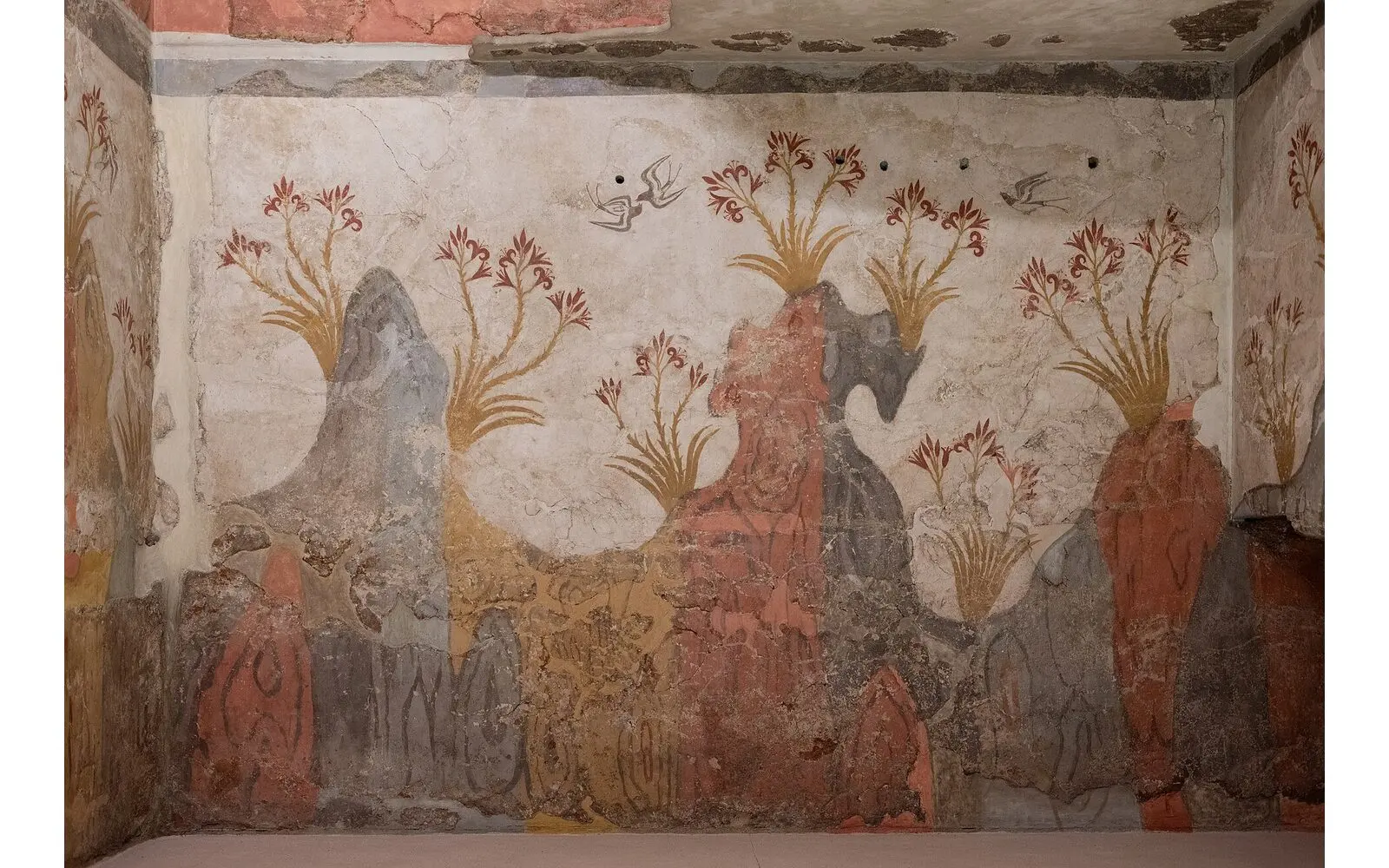
Wall painting is directly connected with architecture and with the history of each place. Its flowering is also linked to economic prosperity. Many ancient wall paintings survive in Egyptian tombs from around 3150 BC, in the Minoan palaces of Crete from 1700-1600 BC, and in Pompeii from 100 BC to AD 79. The earliest surviving examples in Greece come from Minoan Crete. The most famous is the Bull-Leaper, made with the fresco technique. Important wall paintings also survive on Santorini and in the Mycenaean palaces.
Similar wall paintings have been found in other regions around the Mediterranean basin, including Morocco, where many historians believe this art arrived from Crete through exchange and trade. In Egypt, wall paintings appear in tombs, mainly painted with the secco technique. Ancient Egyptians decorated the walls of palaces and tombs with brilliant murals depicting daily life, religious worship and the ruling class.
Important wall paintings also survive from the Roman period, especially in Pompeii, such as those in the Villa of the Mysteries, dated to the first century AD. They include strikingly realistic scenes of daily life, houses and gardens, religious worship and relations between the sexes. Pompeii's prosperity as an agricultural and commercial centre encouraged artistic expression, especially wall painting. The simple character of its buildings favoured the use of mural decoration. The refined technique and durability of these paintings over time remain remarkable.
During the late Roman period, the first Christians living in Rome painted the catacombs with Christian symbols and scenes from the Bible. Later, the Byzantines decorated places of worship as well as secular and public buildings with wall paintings. The era of the Byzantine Empire, after Christianity prevailed as the official religion, left a large number of murals in churches and monasteries in Greece, Cyprus, Ephesus, Cappadocia and Antioch.
During the Renaissance, wall painting reached its height, especially in Italy, where most government buildings and churches had rich mural decoration. The frescoes of Michelangelo in the Sistine Chapel in Rome are the characteristic example.
The technique of wall painting in the Mediterranean has been known since prehistoric times and remains broadly similar across the periods mentioned. Differences concern the use of materials according to place and available choices, economic prosperity, climatic conditions, the architectural structure and the personal style of each artist.
A wall painting is basically composed of the wall structure that acts as support, the mortar that forms the ground of the work, and the painted surface. Walls were usually built of stone or brick and were covered with mortar so they could serve as a painting support. The usual ingredients of wall plaster were sand, an inert material, and lime, calcium hydroxide Ca(OH)2, the active material; with water they become mortar. As the water evaporates, the lime crystallises around the grains of sand, and its crystals penetrate the brick and stone of the wall, securing the cohesion between lime and sand. Sometimes the inner surface was coated with pitch before plastering, to make it waterproof. Depending on climate and wall type, tile dust or brick dust, goat hair, plant fibres or finely chopped straw could be added to the plaster for greater absorbency, cohesion and crack-free drying. The final mortar layers were finer: the proportion of lime increased and it was mixed with a finer inert material, such as marble dust, which is white and gives a smooth surface.
One painting technique of wall painting is fresco, or buon fresco, painting with lime colours on damp, fresh mortar. In this technique, powdered pigment, dissolved in water, is spread on the surface; the lime envelops the grains and incorporates the colours into the body of the wall together with the other elements of the mortar. Fresco has no paint layer separate from the mortar itself, so flakes of colour cannot detach without part of the mortar detaching with them. Only colours added al secco, on dry mortar, or colours bound with a sticky substance can form a film above the mortar that may later peel.
Two special conditions apply in fresco. First, only pigments that do not react chemically with lime can be used, so the range of colours is limited. Second, only a thin, transparent coating of pigment can be applied, so that the mortar is not loaded with more grains than the lime can naturally absorb as it dries. Colours that withstand lime oxidation include earthy reds, ochres, umbers, lapis lazuli, smalt, terre verte, ultramarine blue and cobalt green. If the process is not adulterated, fresco has a distinctive surface brilliance caused by the bright white of the plaster showing through the transparent colours. That brilliance is never achieved if the colours are mixed beforehand with white before being applied. Another limit of this technique is that it could be used only in seasons without cold weather.
In the fresco technique, the fine plaster layer covered only as much of the work as could be finished in one day, and corrections could be made only while the wall was still wet. True fresco is recognised by the successive sections of the painted surface, marked by these joins. In many cases, because the painting could not be completed in a single day, the sections done on the following day began to stand out after centuries, giving non-specialists the impression of overpainting.
In large wall paintings, the painter had many assistants, each responsible for a task, so that the mural could be completed as quickly as possible. With many artists involved, there was a risk that the unity of the artistic style would be broken. The fresco technique was therefore demanding and allowed no delay. The work required speed, and therefore artistic skill, stability and precision in drawing and modelling.
Painting with lime was not suitable for the careful and slow execution of small details, which could be achieved by painting on a dry wall. Another technique encountered is secco, or dry-wall painting on dried plaster. In this method the binder might be egg, wax, glue such as casein, rabbit-skin glue or gelatin, or even oil, applied to a plastered and dry wall. The plaster preparation again used lime mixed with sand, while straw, goat hair or plant fibre, separately or mixed, served as binding reinforcement and was usually applied in one layer. In egg painting, the wall was coated with egg yolk, often also providing the first colour tone. Egg tempera was used on walls to supplement painting methods based on lime as binder, but it was laborious and usually limited to strengthening a visual effect. Egg tempera wall painting, without the protection of another binder, tended to darken when exposed to air.
Sometimes mural painting was done with egg tempera without any lime-paint underlayer. Before applying the colours, the wall was commonly coated with glue to reduce the absorbency of the plaster and make the colours easier to handle. Glue was also used as a binder, more often than egg. Although it allowed walls to be painted quickly and easily, cleaning them with water caused irreversible damage. Casein has been used since antiquity as a colour binder in wall painting and, after drying, does not soften with moisture. For this purpose fresh myzithra cheese was mixed with lime at a ratio of about 1:5. Another technique used on walls was oil, but it flakes quickly and does not integrate well into the mortar, because oil is not compatible with the water in the plaster.
Even works using the encaustic technique have been created. The basic preparation of the wall for this method was similar to fresco, but the surface had to be completely dry during application; otherwise the colours would lift. After the wax dried, it was rubbed with a soft cloth, giving a fine matte texture. This method is ideal for exterior surfaces because wax is hydrophobic, does not absorb moisture and resists atmospheric acids. Other uses of beeswax in wall painting include mixing it with lime or casein, dissolving it in turpentine or fluid balsams, or melting white beeswax in boiling water and adding ammonia. The colours do not differ greatly from those used in the fresco technique.
In sixteenth-century Europe, oil painting on canvas came into use. It had the advantage that the painter could complete the work in the studio and then incorporate it into the wall or ceiling. The disadvantage was that such wall paintings did not have the same luminosity; moreover, the pigments yellowed because of the binder and oxidised as they interacted with environmental conditions.
Using the traditional method of fresco based on good lime, wall paintings can last for centuries, provided they are not wetted and are protected above all from moisture, which can cause complete destruction.
Marina Avgerinou
Conservator of antiquities and works of art - icon painter



Comments
Share your thoughts about this article.
No comments yet. Be the first to comment.
Submit a comment